Completed Event: Track and Field at Battle on the Bayou on April 3, 2026 ,
Final

Track and Field
at Battle on the Bayou


February 22, 2017 | Track and Field
NORMAN – If you pass someone on the OU sidewalks who looks like Clark Kent, you aren't imagining it. Not Superman's human disguise, this person does fly but has yet to do so with a cape on and phone booths are probably safe.
You've just passed Everette Favor, a redshirt senior on the OU men's track and field team. In his fifth year, the Houston product has made it through two years of battling injuries and no less than seven coaching changes. His reward for that persistence was a petroleum engineering diploma from the Mewbourne College of Earth and Energy in December and a senior season of competition that is what you hope all student-athletes experience in their final year of competition.
Personal records have been set and broken and Favor is jumping better than he ever has. He won the season opener on Jan. 14, the Sooner Opener, with a 16-0.75 and the Mark Colligan Memorial Invitational with an even better jump, 16-10.75. He added a PR, 17-6.50, on his way to a victory at the J.D. Martin Invitational, then won the Armory Track Invitational with a 16-10.75. His final indoor competition before this week's Big 12 Indoor Championship, the Tyson Invitational, produced a 17-4.50 and a seventh-place finish.
This year marks his first since the 2014 indoor season to compete in more than one indoor meet.
To understand how special this season is, though, you need to go back to the beginning and the summer of 2013.

Favor began vaulting in seventh grade when a favorite teacher became the pole vault coach at the junior high level. “A bunch of my buddies decided to do it, so I joined them. I kept on vaulting after that first year while most of them didn't,” Favor says. “I was an OK vaulter until I decided to focus on vaulting and quit playing football after my sophomore year. Once I did that, the jumps got bigger and higher.”
Enter the University of Oklahoma and Favor signed with the Sooners – more on this later. Before he got to campus, he got a call from the person he had interacted with the most during his recruiting period. The call was to tell him that the coach had accepted a full-time job at another school. That led to a second coach and two months later, that coach had accepted a full-time job at another school.
The director of operations began working with the vaulters. A distance runner as a competitor, Favor and the other vaulters found that their warmups now included yoga mats and a completely different approach to strength training. Still, the freshman found success. He finished ninth at the Big 12 Indoor and Outdoor Championships with 16-0.00-plus clearances. He registered a 17-1.00 during the indoor season while his outdoor best was a 16-6.75. He also had a coach who had worked with pole vaulters.
In July, he got a pair of phone calls, one to tell him that OU's head track and field coach had resigned to take another job and all but one of the staff members were heading to new jobs. Then, about a week later he got a second call and this one was much different.
“When I was at Texas A&M, I had recruited Everette. I was very impressed with the way he handled the recruiting process, even though he didn't sign with us. He was my first call when I got this job, in part because I was so excited that we were eventually going to be on the same team together,” current OU head coach Jim VanHootegem explains. “I knew he was going to be a solid leader for us and he was the kind of student-athlete who could really help with the transition to a mostly new staff.”
As the new staff came into the program, Favor continued to train and he was improving as he worked with the vertical jumps coach. He cleared 17-4.50 at the Razorback Invitational to establish an improved career mark and he finished eighth at the Big 12 Indoor, his first time to score points in the conference meet. He continued jumping with consistency through the outdoor season. He won the John Jacobs title with a career best of 17-0.75, his only clearance of 17 feet that season.
During the summer between his sophomore and junior years, Favor began to experience pain in his knee. Since he had never been injured before, he kept the depth of the pain from the trainers and his coaches and continued to train. Ultimately, his continued training and the mistakes he was making in the way he ran and the way he lifted led to him having to shut down. He rehabbed throughout the fall and the 2015 indoor season as he pointed to the outdoor season and a healthy return.
“I was having a lot of pain in my knee around the area of my left patella tendon. I was running incorrectly and I kept trying to run faster. I wasn't lifting right and I carried the pole way too low. Basically, instead of helping myself get better, I was just messing everything up,” Favor explains. “We were looking at everything, trying to find the source of the pain, the source of the problem and part of it was me.”
He opened the outdoor season with a low height for him and then cleared 16-0.75 at the Texas Relays before the pain forced him to shut down once again and he lost the rest of that outdoor season. He continued having the pain despite cutting back on training. The fall of 2015 was a tough one for Favor. He wondered if he would ever vault again. He hated being someone standing on the sideline, cheering his teammates on while he really wanted to be out competing. He feared he was taking the roster spot of someone who could be helping the team.
Favor kept working with the track and field team's sports medicine and physical therapy people, doing daily therapy, and he still wasn't being totally honest about the depth of the pain. Finally, his body had enough and while working out during finals week that December, he severely pulled his quad, a very key muscle as you try to generate the force needed to sail/fly over a metal bar 17 feet above the ground. He took the rest of the break off and tried to take it easy on his aching leg. He kept rehabbing with a goal to return to the team. He did return – for one meet – and he pulled the quad again. That became the constant struggle – rehab, then go compete and pull the quad. In reality, he was his own worst enemy, rehabbing then returning to competition, all while running incorrectly and being technically incorrect in his jumping.
He was able to compete in three meets in the 2016 outdoor season after jumping once during the indoor season. He finished ninth at the Big 12 Outdoor with a 16-6.75. The fact that he was able to clear a height like that was a testament to his talent and his will. Unfortunately, the pain continued and Favor had to face the last option – surgery.
“We had tried everything we could do to keep me from having to undergo surgery. I really didn't want to do it but I really had no choice. I would work at rehab, go back to compete and pull the quad. Nothing we tried – and we tried everyting – was breaking that cycle. And I still wasn't being completely honest with anyone but my Dad. He really was the only one who knew how much I was hurting and how frustrated I was.,” Favor adds.
After three years with the same coach, there was another coaching change and that added to his concerns. How would a new coach deal with someone who had barely competed for two solid years? “The coaches were all supportive of me and I can't say enough of Geoff (Lau) and Luke (Spitz), our sport medicine people," says Favor. "They built plans, they adjusted plans, they probably threw plans away and started all over again. No one ever gave up on me and that kept me from giving up on myself.
“I was at a point that I didn't know if I could be on the sidelines again, watching my teammates do things that I couldn't do. I didn't want to take up a spot. I just didn't know if I could do the rehab again and experience another setback. My Dad encouraged me to try the surgery, Coach V supported me as did Geoff and Luke. They were always positive – they were always there for the 90-minutes of rehab. It became obvious that surgery was the last resort and we had tried everything else.”
“I really can not say enough about the support and the commitment I got every day. It came from my jump group, my other teammates, the coaches, all the other support staff and especially Geoff (Lau) and Luke (Spitz). I don't know where I would be without those two."- Everette Favor
With all approaches exhausted and with the support he got from his family and the Sooners, Favor underwent surgery last summer. The doctors did a patella debridement. Typical recovery time for that kind of surgery is six months from surgery to light sprinting. No time frame was given for rehab surgery to sprinting down a runway to plant a pole. For three weeks after the surgery, he spent every day on the couch with a machine attached to his leg that straightened his surgically repaired knee.
“I started light rehab and worked my way back to walking on a treadmill. I was motivated because I wanted to be back with my teammates, jumping, once we hit that part of the preseason. I wanted to be able to start doing short jumps by November, about 4.5 months after surgery. I didn't want to be too far behind and I did not want any setbacks. I did everything that Luke and Jeff had laid out and they adjusted the plan as needed. I can't say enough about the caring and commitment they showed me during this really long process.”
After a month, Favor was up to underwater walking and light jogging on a treadmill. He progressed from that to light jogging on the grass. The first two months of practice, Favor couldn't rejoin his teammates as he couldn't do the full team warmup. Still, he continued to get the full support of his teammates, coaches and staff.
He was back with his teammates on a limited level in November and the focus turned to the first meet, scheduled for Jan. 14.
“We and I mean everyone had worked very hard and we had kept to our plan for rehab and working back into meet shape,” Favor says. “I really can not say enough about the support and the commitment I got every day. It came from my jump group, my other teammates, the coaches, all the other support staff and especially Geoff and Luke. I don't know where I would be without those two.
“We met the goal and I was practicing with my group. I was jumping and it felt better than it had in a long time. Coach Langley worked with me on all of my mechanics, ALL of my mechanics. We think it was a combination of my bad mechanics, especially the way I ran, plus the pressure I put on myself to keep doing more, even though the pain was present. And my lack of honesty with people when it really did hurt. I was trying to run too hard,” Favors continues.
“It is so awesome to go to practice every day and train with my teammates. We are able to work on technique and I really don't worry about injury or that intense pain. I still do some rehab but it usually isn't every day. I am having fun and I am having success. I am able to be that leader I want to be, especially as young as our group is. My mental approach has changed and every meet, every practice I don't worry about getting hurt. I worry about not meeting my own standard.
“I also get to be a mentor now that I am actually working with the group and competing,” he continues. “I like to see myself as a role model. We have a very young pole vault group and they have been so receptive to me. We are improving as a group and I get to be a part of that.”
He sits, days away from the final indoor Big 12 Championship, and reflects on a career that has taken more turns than a badly formed pretzel and he is happy to be where he is.
Jeral Langley came to OU last July after great success at the University of Miami. His first encounter with Favor, while limited, made him think good things about this senior.
“Our first time together as a group, Everette was still in the early rehab phase,” Langley remembers. “He couldn't run with the group but when he did move, I could see his potential. I watched his rehab and began to realize the talent he had. As he got healthy from the surgery, we began to work on his mechanics, starting with the running because that is where everything – from success in the pole vault to the injury he had been suffering from – starts. The way he ran it was obvious that there were issues that we had to correct. Geoff and Luke did a great job getting him stronger and make subtle changes in the way he ran. Then, when he was cleared to return to practice with the group, we continued to work on those mechanics.
“As he improved and was able to work on the mechanics of running, I emphasized that is wasn't how hard he ran but how technically correct he was running that we needed to focus on,” Langley continues. “Even if he was running at 50 percent, I wanted him to focus on what we worked on the how. I was much more concerned with the how and not the how much.
“That first day of practice when he picked up a pole and I watched him leave the ground, I knew we had something.”

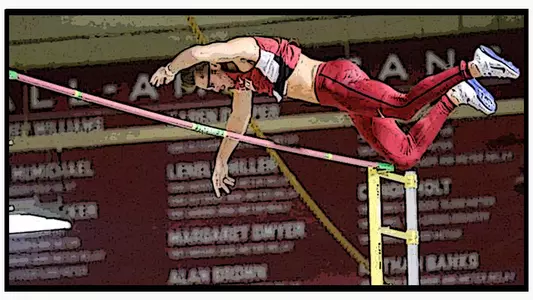
The pole vault is one of those events that builds on prior actions. The vaulter must have a good approach as he approaches the end of the runway. There has to be a successful plant and when that happens, the energy generated by the approach is transferred to the pole to hurl the vaulter into the air. The inversion phase, flying upside down toward the bar as the pole recoils and snaps the vaulter up, sets up the swing. That action gets the vaulter over the bar and if successful, headed to a landing on his back with the bar still in place.
Like the vault itself, the technique of the vault is cumulative. If the vaulter carries the pole low, like Favor often did, it moves the center of the body out. Favor's way of running, described as “more of a shuffle” by his event coach, combined with the position of the 6- to 10-pound, 16-foot pole, caused Favor to “sit through” the takeoff. When vaulters carry their speed through the takeoff, as Favor was doing, freak injuries happen, according to Langley. That's why the technique is so important to the success of the vault.
As the two continued to work and the season started, Favor began having success and that's where another piece of the puzzle fits in, one that athlete and coach are well aware of. “As you continue to have success and get closer to a PR bar, you think you have to do things differently. That leads you back to that place where the technique starts to fall apart,” Langley explains. “It happens in every event. Everyone has a ceiling, a maximum mark. The closer you get to that ceiling, the more your technique can get in the way. You also have to accept that improvements are going to be measured in inches, rather than feet like they were early in your career.”
“We are very process oriented as a program,” adds VanHootegem. “We don't just recruit talent as we want our student-athletes to understand that there is a process to success in their events. They are all talented enough but are they doing things the right way. Everette is a perfect example of that for all his teammates. It was something I saw in him when I was recruiting him for A&M.
“He had a feel for the event, for getting over the bar. He also had a lot of character and he had the desire to improve. Sometimes, you find a highly talented athlete who thinks he has figured everything out and they aren't very coachable. Everette wasn't like that. He had talent, character and humility. He is a great leader on our team because of that combination and an even better role model.”
"There was a lot of work to get him back to where he is, even better than he was, and now we are all seeing how that hard work has paid off.”
- Head Coach Jim VanHootegem
“I try to treat all of my athletes the same whether they are hurt or healthy. Everette and I are still cleaning up things and we will continue to do that. I am more of a quality guy rather than a quantity guy,” Langley says. “With Everette, I believe the best is yet to come. The most valuable thing the he brings to our team is that he demonstrates every time he jumps that this is what it takes to succeed. He is jumping well, he is competing well. He has a willingness to try new things. In all our practices and competitions, I have yet to see him run through. Every jump counts for him.”
VanHootegem takes is a step farther. “Our team has seen what Everette has been through. He put a lot of trust in the people who were working with him. There was no guarantee that the surgery would make him better. He had to dig deep to find his desire to vault again. He accepted there was no magic fix. There would be therapy, he would have to re-educate himself, with a lot of help, in the technique. There was a lot of work to get him back to where he is, even better than he was, and now we are all seeing how that hard work has paid off.”
In a story with plenty of twists, this one might have the most significant. As Favor continued working on mechanics and technique as he competed, the J.D. Martin Invitational approached. Named for the long time OU head coach, Martin was an All-American in the pole vault. As the pole vault continued in the meet, vaulters fell out of the competition for failing to post a legal clearance. Other events on the meet schedule finished and finally the only event left was pole vault and the only jumpers left were Favor and a non-collegiate vaulter. Each continued to clear heights until the bar was moved up to 17-6.50, a mark better than any Favor had cleared in competition since 2014, his sophomore year. With all the focus on him and his PR attempt, Favor sailed over the bar to establish a PR and everyone celebrated with him.
“That was truly a rare, emotional moment in a meet for all of us,” VanHootegem shares. “Everyone saw him clear his PR and people knew what he had been through to make that bar. It was important for his teammates, who had been here the whole time he battled, and for our new athletes to see.”

It was a special moment for Favor as well. His parents were in the stands as they usually are. His sister and her husband were at the meet and it was their first time to see him vault since high school.
“Everette has worked hard for everything he has gotten,” Langley praises. “There is no magic formula and he accepted that. Everything we have been through – the rehab, the practices, the competition – has been fun for me as a coach to watch. I really believe this is just the tip of the iceberg for Everette. I am really looking forward to watching him in the Big 12 this weekend, hopefully a trip to the indoor NCAA and then a great outdoor season.”
The Rest of the Story
If Hollywood was writing this script, Favor would clear another PR and win a Big 12 title later this week. The reality, according to coach and athlete, is that the Big 12 may be one of, if not, the best conferences in the country for the pole vault. A person could finish off the award stand at the meet, then earn All-America honors in two weeks at the NCAA Indoor. For Favor, a successful meet will have happened if he enters and leaves healthy and he continues to improve. For Langley, his athlete will keep the mechanics working and the vaults clean. For VanHootegem, it will be another opportunity to showcase a student-athlete who has proven you can be successful in both arenas at the University of Oklahoma if you are dedicated to the process.
Degree in hand, Favor will be looking for a job in the exploration and production side of petroleum engineering when the season ends. He knows the market is tough but he is ready to soar in a field he loves just as he has in his event.
Put away that cape, Hollywood. We have our own Super Sooner!