Completed Event: Men's Gymnastics versus Ohio State on April 17, 2026 , Win , 322.825, to, 320.294
Final

Men's Gymnastics
322.825
vs Ohio State
320.294


February 20, 2017 | Men's Gymnastics
Imagine being a student-athlete and standing proudly atop a podium as the national champion of your sport. Years spent training, years of blood, sweat and tears all culminating in one triumphant moment. All eyes trained on the best the sport has to offer.
Now imagine being there without your teammates.
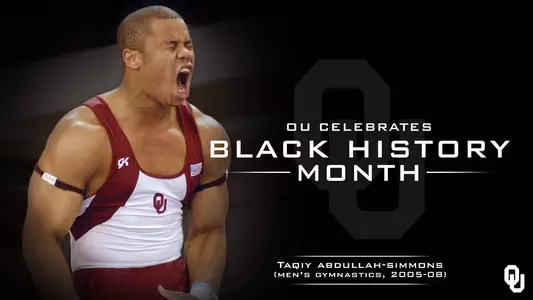
In 2007, Taqiy Abdullah-Simmons, now an OU assistant coach for the top-ranked and defending national champion Oklahoma men's gymnastics team, did just that. He reached the pinnacle of individual achievement by winning the all-around title at the NCAA Championships.
More significantly, he had become the first African-American gymnast ever to win the all-around. He had written his name in history.
He should have been euphoric. But a selfless commitment to his teammates and their tireless pursuit would delay those feelings.
Abdullah-Simmons grew up in Philadelphia, an area not particularly known for gymnastics. As a kid his family had to drive 45 minutes to his practice gym, but his pedigree quickly led to a passion for the sport.
"I was watching the Olympics in 1992 and I think that is what got me really wanting to flip around the house," Abdullah-Simmons said. "My mom was a gymnast, her mother was a gymnast, so gymnastics kind of runs in the blood just a little bit. Then my brother and I started watching gymnastics and then we started right after that."
His talent quickly became evident. By age 7 his coaches moved him from the development classes to the competitive team and, training alongside his brother, Mubarak Abdullah-Simmons, his ability blossomed from there.
Competing in a sport with little African-American participation, Abdullah-Simmons faced a unique set of challenges as a junior gymnast, but with the support of his parents and siblings he adopted a persevering mindset.
"I was young and naive. I could always tell if I was the only African-American competing or if I felt my scores were a touch lower, but who knows."
- Taqiy Abdullah-Simmons
"I was young and naive," Abdullah-Simmons described. "My parents always told me not to pay attention to that, so generally I did not. I could always tell if I was the only African-American competing or if I felt my scores were a touch lower but who knows. I don't like to think about it like that because over time you cannot really worry about those things, you just have to live your life and move forward."
And move forward he did. He became one of the top junior gymnasts in the country and Sooner head coach Mark Williams had his eye on him. Williams also had an ace up his sleeve.
Mubarak Abdullah-Simmons was looking for a place to compete collegiately. Cue Williams.
"Taqiy was one of the best guys in the country and I had gotten word that his brother was eligible and was looking for a school," Williams explained. "I was smart enough to know that if we got his brother first Taqiy would be more interested in Oklahoma. We went that route so we could get both of them."

Taqiy (foreground) and his brother Mubarek (back right, yelling) together on OU's 2005 title team.
So around the same time Taylor Griffin was paving the way for younger brother Blake to make a splash with the Sooner basketball team, the Abdullah-Simmons brothers were doing the same thing just across the street from the Lloyd Noble Center at the Sam Viersen Gymnastics Center.
"Mark did a great job recruiting him because he wasn't going to get offered a full scholarship," Abdullah-Simmons said. "But he knew if he recruited my brother I would likely follow, and in turn I did. Now the rest is history."
Abdullah-Simmons' arrival in Norman took some adjustment however.
It's a common story for Sooner gymnasts. They arrive on campus from the junior scene where they have competed as individuals and are thrust into a team-first atmosphere where every opportunity must be earned in the pressure cooker of the nation's toughest training regimen.
In 2005 when he stepped on campus the Sooners had just finished a second-place finish at NCAAs after winning national titles in 2002 and 2003.
"I think it was a bigger adjustment than he realized it would be," Williams recalled. "His brother was a little more suited to making it work, but Taqiy was already a star. It was a little harder for him because he didn't just come in and everything was wonderful. We told him this is how we've been good so you need to do these things and if you don't you won't compete."
Williams' legendary program is wholly merit based. Student-athletes must compete for spots in the lineup. Future Olympians struggle right alongside walk-ons for coveted spots in the lineup. In this environment Abdullah-Simmons thrived. He developed into one of the best gymnasts in the nation and helped lead his teams to NCAA national titles in three of his four years. It was in that tricky "off year" that he would make history alone.
Abdullah-Simmons admits that a stereotype exists for African-American gymnasts. He says they are often pushed toward or associated with events that are thought to require the most strength and power. Abdullah-Simmons wanted to alter that categorization, at least in his case.
"I started to pay attention to other events other than floor and vault," he explained. "I did not want to be considered just a floor and vault gymnast, I really wanted to make sure that I was well rounded. I always just did my own thing; I really did my best not to pay attention to the outside or what other people thought of me."
By 2007, his efforts had already led to back-to-back national championships for Oklahoma. Entering a new season the expectations couldn't have been any higher. There would be a third straight title. Or so they hoped.
A string of injuries and a family emergency left the Sooners shorthanded entering the 2007 NCAA Championships. Starting on parallel bars, then-future Olympian Jonathan Horton fell during his routine; an omen of what was to come, the Sooners finished in second place. But what was a disappointing weekend for Oklahoma, was one of triumph for Abdullah-Simmons. He had broken through and claimed his first individual national title, and it had come in symbolic fashion.

The all-around title was bittersweet because he wasn't on the podium with his teammates.
He wasn't the floor champion.
He wasn't the vault champion.
He was the all-around champion.
He had shaken free of stereotype and proved to the gymnastics world that he was the best and most complete gymnast in the country.
Yet so fully had he committed to Williams' team-first ideology that standing atop the podium, his weighty accomplishment landed softly.
"When it happened, I just wasn't super thrilled because we always go into the competition and win as a team and that was the one year that we did not win, we got second place," he recalled. "It was a very bittersweet moment. Our goal was to obviously win as a team, and at the awards ceremony I was standing in first place by myself."
"It was a very bittersweet moment. Our goal was to obviously win as a team, and at the awards ceremony I was standing in first place by myself."
"After the meet I was like, 'Wow, he won the all-around,'" Williams said. "'I think you're the first African-American to win the all-around.' The sense, even though Taqiy had won the all-around, was defeat. We had come in second after being national champions two years in a row and everyone was kind of bummed. In terms of history I wanted him to appreciate what he had done, but in the moment it was difficult because our goal is always about the team."
Abdullah-Simmons led Oklahoma to yet another team title in 2008, once again summiting the podium with the Sooner brethren.


Abdullah-Simmons helped the Sooners to three NCAA team titles (2005, '06 & '08) in four years.
Following graduation he spent some time coaching before he ultimately went to work for Disney, putting his prodigious gymnastics talents to use performing in the The Festival of the Lion King in Orlando, Fla. The show is one of Disney World's most popular attractions. After his stint with Disney he moved on to Cirque Du Soleil, also in Orlando.
"Right after college I started coaching women's gymnastics for about a year and a half then realized I still wanted to be active," Abdullah-Simmons explained. "I auditioned for The Festival of the Lion King. I had that job for two years and it was an awesome experience to work at Disney World and to really put on a show in front of thousands of people daily. It was definitely a life goal of mine to perform and having that opportunity at Disney World, a place I was never able to visit as a kid because we didn't have enough money -- on orientation day I was like a little kid just looking around. That was awesome.

Abdullah-Simmons in The Festival of the Lion King at Disney World.
"Then I had the opportunity to go to Cirque du Soleil. That was a really short-lived time. Unfortunately, four weeks into the job I broke my neck."
Performing a trampoline stunt, he had a fall and landed on his face. A broken neck landed him in surgery the next day. But as fate would have it, there was much more gymnastics in store for Abdullah-Simmons. Seven months into his recovery, he got a call and an offer from his old college coach. Would he like to join the Sooner family again as an assistant coach?
"It was just one of those blessings because I was at the point in my recovery where I wondered if I would continue to perform," he amazed. "I did not want to because I had had about eight surgeries. To continue to put myself there again after an injury like that...I should just walk away and be happy. So this job came at a perfect time."
The 2016 season marked his first year alongside Williams as a coach. The three-time NCAA team champion knew a thing or two about repeating and he helped guide the once-again-dominant Sooners to a second straight national title.
"It was great," Abdullah-Simmons said of his first season. "I cannot say enough about this opportunity. They had just won their first national championship since I had left so I was very excited we were back on that winning track here. My first two days here I saw all the talent and knew this was going to be a lot of fun. Ever since then it has just been hit the ground running."
The Sooners are off to much the same start in 2017, and just like in 2007, there are expectations of a three-peat, which is about the only thing Williams has not accomplished in his 18 historic seasons at OU. In fact, no team has won more than two titles in a row since Nebraska won five straight in the early 80s. Abdullah-Simmons is ready to ensure this year's Sooners learn from his experience and get the job done in April.
"It is just another year to me," he deadpanned. "I have gone through four years as an athlete and now this is second year here so I know what to expect and the guys know what to expect. So right now we are just trying to push and win again. It is fun in the process but it is a grind. For the guys it is a grind, for our coaches it is a grind. It shows the commitment we have toward the success of the program."
As for his own accomplishments, time has put his 2007 all-around title into perspective. The sting of 2007's second-place team finish has faded a bit, replaced by a pride in his pioneering accomplishment.
"That was really kind of awkward," he remembered. "But as time has passed I have allowed myself to enjoy that accomplishment more and more."
This is the third in a four-part series celebrating Black History Month this February:

Michael Pace
Baseball, 1977

Phylesha Whaley
WBB, 1996-2000

Taqiy Abdullah-Simmons
MGym, 2005-08

Patrice Arrington
Volleyball, 1994-97