Upcoming Event: Soccer versus Northwestern State on August 12, 2026 at 7 p.m.
7 p.m.
Soccer
vs Northwestern State


November 02, 2016 | Soccer
When Matt Potter attended a U.S. soccer licensing course back in 1995, he had no idea he was walking on the soil he eventually would call home.
The camp was held at various locations on the University of Oklahoma campus, including the Timberdell Field next to the school's outdoor swimming pool and across Jenkins Avenue on the recreation fields adjacent to Reaves Park.
Just one year later, the OU women's soccer program was born. And 16 years after that, Potter was hired as that program's head coach. Consider it fate, kismet, good fortune or all the above, because as the Sooners celebrate their 20th season in the Big 12 Conference, perhaps never before has the program been more competitive.
This is thanks in part to a native of Mere, England, who opted to return to a foreign land called Norman, Okla. “The place wasn't completely strange to me when I returned here (to become the coach in 2012),” Potter said, trying to recall the particulars of his 1995 visit to OU, “but it definitely is strange I find myself sitting in this seat now.”
"A big part of the fabric of who we are as a program now is about understanding and appreciating those who came before us."
— Matt Potter
When the No. 4-seeded Sooners (12-5-2; 4-3-1) begin Big 12 Championship play Wednesday with a 2 p.m. contest against Iowa State (10-7-1; 3-4-1) at Swope Soccer Village in Kansas City, Mo., they will do so with a No. 9 national RPI ranking and carrying a school-record six All-Big 12 selections on their roster. Ten OU players also were named to Academic All-Big 12 teams.
Beat the Cyclones and the Sooners will face top-ranked West Virginia (16-1-1; 8-0) or No. 8-seeded Texas Tech (9-7-2; 2-6) on Friday at 4:30 p.m.
Fare well at this week's Big 12 Championship and the Sooners might get a chance to host an NCAA Tournament opening-round match for the second time in the last three seasons.
Though it took 20 seasons to get to this point, Potter and his players are cognizant of those who came before them. “A big part of the fabric of who we are as a program now is about understanding and appreciating those who came before us,” Potter explained. “Our players are very much aware this is an anniversary season and they want to continue the work done by those before them. That's a very important part of who we've become today.”
When the Big 12 was formed in the 1996-97 academic year, it was a no-brainer to add women's soccer because 10 of the conference's 12 schools already had programs – the lone exceptions being OU and Kansas State. (No Big 12 school had a men's soccer program, other than at a club level.)

The 2003 Sooners advanced to the NCAA Tournament for the first time in program history.
Although the inaugural season of OU women's soccer coincided with the Big 12's debut, the Sooners did not compete in conference play to allow a transition period. (KSU did the same this season and will join the Big 12 in 2017).
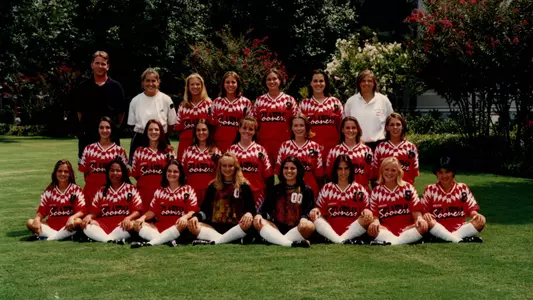
It was tough sledding from the start for coach Bettina Fletcher as OU lost its first 13 matches by a combined score of 48-6 (eight shutouts) before winning the season finale 3-2 at McNeese State. The Sooners played just two home games that first season, using an open field with temporary bleachers at Griffin Community Park on 12th and Robinson north of campus.
Home games later were staged at Norman North High School before relocating in 2000 to the OU Soccer Complex. Since the 2006 completion of a $4.5-million renovation that boosted the seating capacity to 3,500 and added numerous amenities, John Crain Field has been considered among the nation's premier collegiate soccer facilities.
The Sooners' first season in the Big 12 was much like their first season of existence, finishing 2-14 overall and 1-9 in 1997. Fletcher coached OU's first three seasons and then was replaced by Randy Evans.
Jamie Farmer (now Steele), works as an advisor at OU and played for the Sooners from 1999-2002. She committed to the Sooners because of Fletcher, but never got to play for her. “I loved Bettina,” Farmer said. “She was awesome.”
Farmer now coaches the Norman Celtic under-11 competitive girls team that frequently attends OU home matches. “I think it's really cool that in the local community of soccer, OU is an icon,” Farmer said. “My team loves going to their games. It's awesome. It instills a goal for these kids that they all want to play for OU soccer.”

Oklahoma made its second trip to the NCAA postseason in 2010.
Allyson Kucera (2004-07), who is now a prosecutor for the District Attorney's office in Fort Worth, listed multiple reasons for leaving her home state of Texas to play for OU. “Oh, my gosh. There's too many reasons why I decided to go there,” Kucera said. “Great school. Great program. I loved the university, the athletic department, they were all about enhancing the entire university experience all the way through. They really had a great platform and they lived up to every promise they made. I loved it.”
Under Evans in 2003, the Sooners made their first NCAA Tournament appearance, losing 1-0 at No. 7-ranked Tennessee. A second NCAA appearance seemed imminent two years later when OU started out 11-1, but closed the season 2-5-1 with a first-round loss at the Big 12 Championship that likely eliminated the Sooners from postseason consideration. “We deserved to go,” Kucera said, point-blank.
In 2010, under coach Nicole Nelson, OU went 12-8-3, placed second in the Big 12 Championship and lost to Washington in the opening round of the NCAA Tournament.
In 2014, the third season under Potter, the Sooners made their third NCAA appearance and hosted their first-ever postseason match, which ended with a heartbreaking 3-2 overtime loss to Arkansas. Abby Hodgen (2011-14) was a senior that season and assisted on the first two goals to help give OU a 2-0 lead after just 15 minutes in the first half.
“My last year kind of validated why I went to OU. I went there to help change the program around,” said Hodgen, who also was recruited by Oklahoma State and Tulsa. “Everywhere I went on my recruiting visits, OU just felt like home. I just couldn't see myself at any other school. It fit everything I wanted. All the girls opened their arms and talked to me. Some of the other visits I didn't feel very welcome, but OU was very welcoming.”

Rachel Ressler, now a senior, celebrates after scoring the first goal in the Sooners' NCAA history, doing so against Arkansas in 2014.
With year No. 20 about to enter the postseason, the Sooners are still looking for their first Big 12 trophy and first NCAA victory in women's soccer.
“Postseason play is a prerequisite to being part of our athletic department,” Potter said. “By putting yourself in a position to win, whether it be Big 12 titles or national titles, we want to compete on a championship level just like everyone else does.”
Molly Richey (2011-14), a walk-on who eventually became team captain as a senior, is now a broadcast analyst for home games and didn't hesitate when asked about the state of soccer at OU. “I think it's awesome,” Richey said. “I don't think it's ever been better, really. He (Potter) has done an awesome job. I think the girls are used to playing tougher opponents and I think that's what's made the difference. I think it continues to boost our program. This senior class has done a tremendous job, which is really cool to see because I was there when they were just babies. I have had the chance to see how much they've improved. They're a fun group to watch.”
Potter said the 20th anniversary has been on his players' minds for the past year. “Former athletes have stopped by and I think celebrating those players and giving ourselves fully into this season is an important part of what we discussed way, way back to the end of last fall,” Potter said.
With an all-time record of 161-204-36, the OU program remains a work in progress. “Success for an athletic program in any sport can be defined in many ways,” Potter said. “Ultimately as coaches we're in a win-loss business, but many coaches – including myself – don't lose sight that it's so much more responsibility than that. It's about developing a student-athlete in their chosen sport and their academic chosen careers. Obviously, your college years are an important time for any individual. Helping shape an individual is something I value and many other coaches do as well.”