Upcoming Event: Men's Basketball versus East Texas A&M on November 2, 2026
Men's Basketball
vs East Texas A&M


June 29, 2011 | Men's Basketball
June 29, 2011
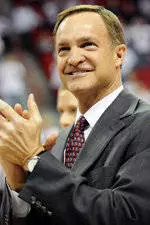
NORMAN, Okla. -- Lon Kruger doesn't have much spare time, and that's just fine with him. Hired April 1 and charged with revitalizing the OU men's basketball program, the new Sooner head coach has been here, there and just about everywhere in between the last three months, learning about Oklahoma, making friends on campus and in the community, and drumming up support for his team. The not-so-minor details of finalizing his staff, getting acquainted with his players and finding a place to live have also occupied a good chunk of his time.
Kruger took a brief break from his chaotic schedule late last week to sit down with SoonerSports.com for a two-part question-and-answer session that touches on a wide variety of topics. This marks the second of two installments of the Q&A. Part one can be viewed by clicking here.
----------
Q: Say you're driving by yourself for a couple hours in your car. What kind of music are you listening to?
A: "My wife and I love going to plays and musicals, and enjoy the music of performances like 'Chicago' or 'Mamma Mia' or 'The Sound of Music.' I know nothing about music, but I know what I enjoy listening to. It's kind of the easy-listening, upbeat, feel-good stuff. Of course now I've added Toby Keith to that list. I enjoy all of his music."
Q: What movies do you list as your favorites?
A: "Oh, gosh. Again, I'll mention 'Sound of Music.' It may sound different, but it's such a feel-good show. Anything related to kids, we always kind of gravitate to that; whether it's something with charities or shows like that. We don't watch a lot of TV, but we like the thrillers and the spy shows and the attorney shows. We might tape something and then watch it later at night."
Q: Do you have a fondest basketball memory as a player?
A: "Having been asked that question over the years, I've generally responded by saying maybe the win at Missouri our last game of our sophomore year. That was for the Big Eight championship. Foreign court, hostile crowd and Coach Stewart's teams were always tough and physical and great at home. So winning the league championship there was probably as satisfying as anything. But then, on the other hand, it's tough to cite something away from Ahearn Fieldhouse because Ahearn crowds were so good. The atmosphere was so good that anytime we lined up there it was special and exciting."
Q: How about as a coach?
A: "I don't know if I have a specific memory. Of course going to the Final Four is special for any team -- the satisfaction a coach gets from watching young people feel great about their work and how it was rewarded by a Final Four trip. In 1998, the team at Illinois winning a share of the Big Ten championship when that hadn't happened there in quite a while and wasn't expected to at that time. The Elite Eight team in 1988 at Kansas State that had beaten Kansas in the Big Eight Tournament and then lost to Kansas three weeks later to go to the Final Four. That was a special team with Mitch Richmond and Steve Henson and that group. But there are so many good memories. We've been blessed in a lot of ways in terms of every stop we've made has been very, very satisfying and enjoyable. We get up every day and love what we do. It's pretty good work."
Q: If you never went into the coaching business, what do you think you'd be doing right now?
A: "Nothing specific really comes to mind. Working with young people in some capacity, I would imagine, because we really like seeing young people and the changes that occur in their lives, during their time in college; seeing their development, working with the parents of these guys as they develop. But I don't know specifically what it would have been."
Q: Won-lost record aside, how did you like coaching in the NBA?
A: "Very much enjoyed the NBA; the only downside to it was the losing. When you're not very good in the NBA you're going to lose a lot because you play a lot of games. Otherwise, it was a great experience. Even getting fired, in a humbling way, was healthy. It was a reminder that it happens in the profession. We'd gone through and had been pretty fortunate to have good players and win games everywhere, and then all of a sudden we didn't win games. It was an eye-opener, but also a very good experience."
Q: What are some of the biggest differences in coaching and relating to NBA players versus college players?
A: "It's different, for sure. I was a little naïve going in, thinking that it was all just going to work out. In the NBA, there are a lot of moving pieces in terms of the front office, the bottom line -- the business aspect of it. And you're coaching players who are in a different stage of their lives. In college, they're all working to get to that next level as it relates to the basketball side of it. In the NBA, they've got their families in a lot of cases, their agents; they've got a lot of people in their group who are involved. But again, that was all part of the experience and it was good."
Q: Who are some of your closest friends in the coaching profession?
A: "You get to know so many people over 30 years and you get to know them in different ways. Dana Altman was on our staff at Kansas State and then went to Creighton and now Oregon; certainly very close with him. Got to know Jim Boylen when I was with the Atlanta Hawks and he was with the Houston Rockets, and then he went to (the University of) Utah. He's a really, really good guy. Roy Williams (formerly at Kansas and now at North Carolina); I've probably played more golf with Roy, by far, at different meetings and things than anyone else in the coaching profession. He came out to the Coaches vs. Cancer golf event in Vegas this year and was great to do that. Frank Martin's brought his Kansas State group to the Coaches vs. Cancer fundraiser all four years and he's been great in that way. But great respect for the Mike Krzyzewskis and Norm Stewarts and people like that who've done it so well for so long."
Q: Can you describe a typical day since you've been named OU head coach?
A: "Depending on the day, typically you're in between 7 and 8:30 in the morning for your first meetings or radio interviews or whatever you have scheduled. But you're meeting with as many people as you can, asking as many questions as you can. The exciting part is to realize the genuine interest that people have for Oklahoma athletics. The basketball tradition is great with the number of terrific coaches and former players who have come through (the program). Having been in the Big Eight I'm very much aware of that, but being here a lot closer to it I'm even more in awe. And attending the Sooner Spectacular (fundraising dinner) at the State Fairgrounds a few weeks ago -- not many people can roll out a list of names like that. The number of Heisman Trophy winners, other football greats and standouts in all sports -- not many universities can do that."
Q: What's your favorite aspect of being a coach?
A: "Generally it's seeing the satisfaction and the spontaneous moments of celebration when the work and the preparation are realized after a big win, and the feelings for one another in the locker room afterwards."
Q: Who has had the biggest influence on you in terms of your basketball career as either a player or a coach?
A: "Clearly, that always starts with parents. I was the oldest of six kids and my dad coached all of our teams growing up. He was clearly at the center of that. Then Ellis Dahl was our high school coach and he had a lot to do with that in basketball. Then Coach Hartman at Kansas State has had a huge, huge influence on everything we've done."
Q: You've made yourself very visible in the public since arriving in Norman. Have you always liked to involve yourself and your teams with the community?
A: "Very much so, absolutely. People want to reach out to, talk to and touch the coach. It's not because they want to talk to Lon Kruger; they want to talk to the coach at Oklahoma. And because of that, it's a natural partnership. If people can use our position to promote a charity or if we can do something to help others because of our position, then it's very natural to do that. Because we want them, in turn, to come to our games, support our players. So we really encourage our guys to get out in the community. That's part of the reason why practices are open to the public. We want people to come, we want them to bring their families, we want them to shoot around with the guys afterwards, we want businesspeople to bring their clients. We want everyone to feel a piece of the ownership, which is the way I think it should be. We've been here three months, and everyone who's been a fan for 30 years, or for however long, has a lot more invested in this thing than I do. So they should have a lot to say about it."
Q: If you could say one thing to OU fans right now, what would it be?
A: "This is going to be fun. We're going to enjoy getting after this. We're going to play in a way that will hopefully make everyone proud and feel good about what's going on. And we want them to take ownership in the program."