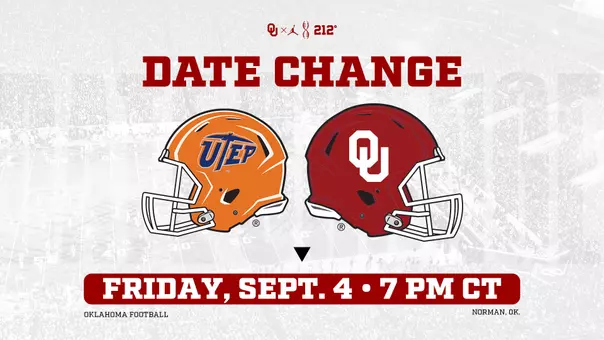
Upcoming Event: Football versus UTEP on September 4, 2026 at 7 p.m. CT
7 p.m. CT
Football
vs UTEP
.png&width=40&height=40&type=webp)


.png&width=40&height=40&type=webp)


August 30, 2018 | Football
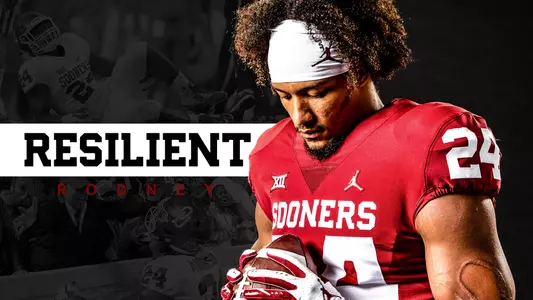
Before running back Rodney Anderson arrived at Oklahoma, he never had to overcome a serious injury. "Pretty injury free for the most part," Anderson said. "Nothing serious."
All that changed shortly after his arrival in January of 2015 during what would have been his final semester as a senior at Katy (Texas) High School.
Anderson missed most of his first spring practice with a sprained MCL. After recovering from that, he sustained a season-ending lower left leg injury while making a tackle in kickoff coverage in just his second game of his freshman season, a pulsating 31-24 double-overtime comeback victory for the Sooners at Tennessee.
"I left high school early to prepare. In a split second, it was taken away," Anderson said. "They already had talked to me about medically redshirting, so I knew I would have time to make it up. I was focused on getting myself back right so I could help the team."
After misery came agony.
During an intrasquad scrimmage in August prior to the 2016 season, Anderson suffered two fractures in his C5 vertebrae. Though the injury did not require surgery, Anderson was instructed to wear a neck brace for three months, a task that took some serious coaxing from the OU medical staff. "I refused at first," Anderson said of wearing the protective brace.
Anderson said enduring the neck injury was far more challenging than his broken leg.
"I've always been pretty mentally stable, but the second one was pretty tough," Anderson said. "It was the most boring injury. You break your neck, you can't do anything. You'd be surprised the little turns that you do. Looking out the side of your eye, (you) even turn your neck a little bit. I couldn't lift. I couldn't do anything but sit and watch. Went to practice. Went to meetings. That was pretty much it.
"I wasn't too concerned with the fact my neck was broken. I was more upset that they told me I couldn't play in the (2016) season. I was mad, I was upset, I just wanted to call my parents ... it was just tough. I didn't really know what to feel or what to think. I was just mad and sad. I had no worries about whether I'd play or not. It was just more of waiting it out. That's the longest I had never not done something."
"I've always been pretty mentally stable, but the second one was pretty tough."
— Rodney Anderson
Despite the emotionally trying times, Anderson said he never contemplated giving up football.
When in need of moral support, Anderson said he didn't lean on one teammate or coach more than another. "I'm pretty close to the whole team," he explained. "I feel it's that way for every position. Everybody wanted me to play, I just wasn't there yet. They always stayed in my corner. They were always helping me if they saw I was down about something. It was more of an internal battle for myself."
Homesickness often overwhelms freshmen, particularly those redshirting or sidelined by injury. Such was not the case for Anderson, however, who said he never considered leaving OU despite the frustration of back-to-back season-ending setbacks. "I love my family to death," Anderson said, "but I've never been homesick in my life."
Even had he stayed healthy from the outset at OU, Anderson somehow had to find some playing time alongside Samaje Perine and Joe Mixon.
Named 2014 Offensive Player of Year by the Houston Touchdown Club, Anderson rushed for 5,493 yards, averaging 144.6 per game and 9.1 per carry for his prep career at Katy High School. In addition to OU, he also received scholarship offers from Alabama, Auburn, Baylor, Texas A&M and others. Anderson initially orally committed to Texas A&M before his junior high school season, de-committed, then chose the Sooners over the Crimson Tide.
A consensus four-star prospect by ESPN, Rivals, Scout and 247Sports, Anderson was the nation's No. 2 running back in country by 247Sports in 2015 and the No. 3 all-purpose back by Rivals.com.
Anderson recalled seeing highlights of Perine rushing for an FBS-record 427 yards as a freshman against Kansas on Nov. 22, 2014. That same year, OU had signed the nation's No. 1 all-purpose back in Mixon.
None of that fazed Anderson, who had orally committed to play for the Sooners in early June of 2014 after spending three days at summer camp in Norman.
"I just wanted the opportunity to play for some great people and a great program," Anderson said. "When it came down to it, it was between Alabama and OU. Those were the last two schools I really paid attention to. I just felt more at home at OU. I've never really been scared of competition or great players. It was really just what the best fit was for me. Playing ball is just playing ball.
"I always feel like I've been pretty levelheaded. A lot of things are just black-and-white to me: You pick somewhere to go, you make the most of the situation you've been put in, and whatever you get out of a situation, you just run with it and do the same thing and then make the best out of that situation."
The hidden benefit of being forced to miss essentially two full seasons is it allowed Anderson an opportunity to concentrate on weight training while rehabbing and he had stark improvements in multiple areas.
Like many running backs who came before him with the Sooners, Anderson qualifies as a physical freak. Heisman Trophy winner and No. 1 overall NFL draft pick Baker Mayfield described Anderson as "definitely a specimen."
Last month, OU's new Director of Sports Performance Bennie Wylie posted a video on Instagram showing Anderson doing a standing vertical jump onto a platform five feet high.
Last October, former defensive teammate Du'Vonta Lampkin tweeted a video of Anderson exiting a pool with a standing vertical leap out of four feet of water.
According to the OU strength staff, Anderson's top marks are 355 pounds on bench, 475 on squat and 315 on clean.
"I feel that I've gotten stronger each year I've been here," Anderson said. "One of the reasons I wasn't too worried about my leg or missing that (true freshman) year — obviously, I wanted to be out there playing — but it gave me a year to work on myself in the weight room. I was looking at the bright side of things and the weight room was the bright side for me. Other than seeing my friends, lifting was the only thing I could do. I got stronger upper body-wise. I just built off of that. After I got off the scooter (used to support his injured leg), it was a matter of catching my legs up and each year I just got stronger."
The 6-foot-1 Anderson weighed 195 pounds when he arrived at OU and bulked up to 230 during the fall semester of 2015 before tapering down to his current weight of 220.
Anderson said he has never struggled to find a comfortable playing weight. "My body fat has always been very low," Anderson said. "I always eat well, so they (coaches) don't care where I'm at as long as I stay the same on the field."
Anderson led the Sooners in rushing last season with 1,161 yards, averaging 6.2 yards-per-carry and scoring 13 touchdowns. He also had five receiving touchdowns on just 17 receptions and averaged 16.5 yards per catch.
Through the first five games, Anderson had amassed just 34 rushing yards on 12 carries. Understandably, perhaps Anderson was tentative having come off a neck injury the previous August.
"If you had asked me back then, I don't think I was hesitating," Anderson said. "I felt like I was going all-out, not holding back. My coaches and parents thought I had more in the tank, but I just didn't let it out. I guess I had a mental block or something."
All that changed when the Sooners played Texas in Dallas, where Anderson powered his way to 48 yards and one touchdown on 10 carries. "I guess I didn't come to realize it until the Texas game and then I just kind of let it all out and started playing," Anderson explained.
The week following the 29-24 victory over the Longhorns, Anderson had a coming-out party with 147 rushing yards on 19 carries (7.7 average), 30 receiving yards on four catches and two touchdowns in a heart-thumping 42-35 victory at Kansas State.
Anderson scored the winning touchdown on a 22-yard sprint down the left sideline at Snyder Family Stadium with :07 left in the game.
The game-winning dash was surreal for Anderson because he was sprinting directly at his mother, Jobie, who was seated in the end zone. (Before each game, Anderson makes sure to spot where she is in the stands.)
"That was just a special moment for both of us," Anderson recalled of the KSU game. "Running down the sideline, I was like just looking at the end zone. She was right there. She was like, 'Go, Go, Go.' I was like, 'I'm trying.' It was really good."

Anderson and his mother, Jobie, share a hug after he scored the game-winner at K-State.
More special moments would soon follow.
After his Kansas State heroics, Anderson entered the starting lineup for the final seven games. Through the first six weeks last season, Anderson averaged 13.7 yards per game and 3.7 yards per carry with two rushing touchdowns. In the final eight games, he averaged 134.9 yards rushing (6.5 per carry) with 11 rushing touchdowns and five touchdown receptions.
Though he could possibly enter the NFL Draft before then, Anderson technically is a redshirt junior now and will be eligible to petition for a sixth year in college after missing two seasons due to injuries.
Big things are expected this season from Anderson, who was a preseason All-Big 12 selection and is considered a Heisman Trophy candidate. He capped last season with 201 rushing yards (7.7 per carry) and two touchdowns in a 54-48 double-overtime loss against No. 3-ranked Georgia in a national semifinal at the Rose Bowl. Afterward, Anderson was peppered with questions about his statistical excellence the second half of the season.
"I didn't even know any of those things until they started asking me about it," Anderson said. "I'm more of a big-picture guy. I was more excited to play again, get a chance to contribute. I'm just blessed to say I was able to get out there."