Upcoming Event: Football versus UTEP on September 4, 2026 at 7 p.m. CT
7 p.m. CT
Football
vs UTEP
.png&width=40&height=40&type=webp)


.png&width=40&height=40&type=webp)


November 18, 2016 | Football
Most people are familiar with the classic black screen and moving green line of an electrocardiogram, or EKG. The rhythmic beeps, dips and spikes are a staple of medical-themed TV shows and movies. What some might not know is that in order to be cleared for football activity at the University of Oklahoma, every student-athlete must undergo an EKG as part of a thorough physical examination.
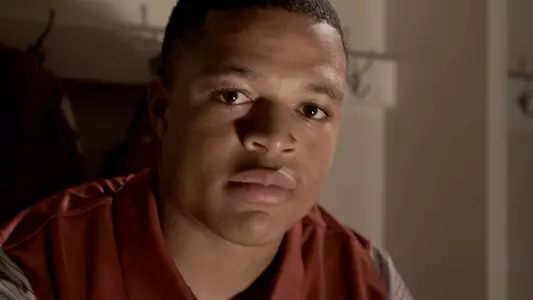
True freshman Jordan Parker went through this test this past summer just like all his teammates. Unlike his teammates, however, Parker's results showed an anomaly.
Parker hails from Pittsburg, Calif., not far from star running back Joe Mixon's stomping grounds, in the Bay Area. After an illustrious career at Pittsburg High School, Parker was rated as a four-star recruit and became one of the top prospects in the talent-rich state of California. He fielded offers from all over the country and was being sought out by college football's elite. Tennessee, UCLA and USC made Parker's short list, but it was Oklahoma's honest pitch that won out.
“This is the only school that recruited me differently than everybody else,” Parker said. “Everybody else really sold me a dream and told me I was going to get this, told me I was going to get that. When I came over here for my official, they told me that I had a chance, and if I wanted to take it then I could go take it. Not just, 'I'm going to give it to you. I'm going to give you this or that.' So I felt like that was the realest to me. I felt like this was the best fit.”
Another reason Parker chose OU? Defensive backs coach Kerry Cooks had created a unique culture within the DB meeting room. The 'wolf pack' as they call themselves had formed a special brotherhood both on and off the field. Parker's given-nothing, earn-everything attitude made for an immediate fit.
Said Cooks: “When I first got on the phone with him I remember him telling me, 'You're not going to have a CB (cornerback) like myself that is going to come out there and want to challenge and match up with the No. 1 wide receiver. This is a high school kid and he's talking like that so his confidence jumped out to me.
“I think in this day and age there are a lot of athletes that feel entitled. When he said that to me it made me acknowledge that he thought, 'Hey man, I don't expect anything to be given to me, and I'll come here and bust my tail and work and earn everything I get.' That is what he has done to this point.”
Parker was all set to join the Sooners for fall camp, but had barely made it to Norman before he would have to rely on his new DB brothers for strength.
Parker's EKG revealed an arrhythmia in his heart. He was diagnosed with Wolff-Parkinson-White syndrome, a rare condition in which an extra electrical pathway between the upper and lower chambers of the heart causes a rapid heartbeat. Parker had shown no symptoms and was unaware of the condition before his physical. More than 1,600 miles from home, the true freshman suddenly saw his football future very much in doubt.
“I didn't really know how to take it because he told me it was a really rare heart condition. I looked it up, and it was like, one in every 10,000 people get it. I just didn't know how to handle it. It was scary, but all of the symptoms that I was supposed to have, I had never felt them, so I really didn't look at it as a big deal, but it was a big deal.”
Cooks sympathized with Parker.
"You can imagine, being a four-star athlete and having his pick to go and play for any college he wanted to go to... and all of a sudden his whole career is in jeopardy."
— Secondary coach Kerry Cooks
“You can imagine you know, being a four-star athlete and having his pick to go and play for any college he wanted to go to,” said the second-year OU secondary coach. “He comes up here and gets his physical and hasn't had any issues with his heart and all of a sudden his whole career is in jeopardy.”
Parker had to make a choice. In order to continue pursuing his dream of playing football at Oklahoma, he would have to undergo a catheter ablation procedure to fix his condition. Surgeons would insert a flexible tube into a blood vessel through his neck and guide it to his heart where they would then correct the problem.
“Really the management of it was an ablation, which is where, for lack of a better term, they identify and map this point in the heart that is the pathway for that signal,” OU head athletic trainer Scott Anderson explained. “They basically burn and interrupt that pathway to stop that signal. The expectation is that this shouldn't bother him for the rest of his life. The consideration was, both in terms of his long-term health and well-being, as well as his athletic activity, this seemed to be the course of action to take. Plus, this is the best place in the world for that. The OU Health Sciences Center is one of the best facilities in the world for that procedure and the best professionals for that in the world are right here in Oklahoma City.”
Cooks' role with Parker quickly turned into one that entailed much more than coaching football.
“Even though I couldn't do anything physically to help him, I felt for him because he is a young man that loved the game,” Cooks said. “I told him lets go through the surgery, let's go through the process and let's see what happens. I'm there for you. I think I called him every day and he got tired of me. I called his mom to keep her informed as well. He had the first surgery and they said two weeks out that he would be able to run.”
But when Parker went in to get clearance, his cardiologist discovered that his condition had not been resolved.
“He said that it was close to somewhere where they didn't want to burn it too much because if they burn it, if the heat was too hot, the radiation would mess my heart up,” Parker said. “They knew while they were doing it because it took longer. My mom told me that she was nervous. It was supposed to be a three-to-four-hour procedure, and it took, like six or seven. So she was nervous.”
The news was devastating to Parker, who had mentally prepared himself for the procedure but not for the possibility of a second.
“That was worse than the first time hearing it, because I felt like it was going to be done. They told me it was going to be done with after the first time. So, I was hurt the second time more than the first time because, again, I just wanted to play football.”

Parker went from being a four-star recruit to not knowing if he would play football again.
“He was just dejected,” Cooks recalled. “A kid that was really lost. He was all the way here in Oklahoma from California. No family here. Who do I talk to? Who do I turn to? You could see it in his eyes and in his face. He loves the game. Probably a lot of depression, very sad. You know all of the negative things that you can think about when you hear the news that something that you love so much is possibly going to come to an end, taken away from you, out of your control. That's pretty devastating.”
Determined not to give up his dream, Parker underwent a second procedure.
“I was on the phone with the doctor and he told me the risks and percentages and stuff,” said Parker, “and I thought about it for like a split second to not get the surgery, but then I thought about it again. I can't turn back now, and I felt like I would be giving up on myself to not get the surgery. So, I just took the risk and got it again.”
The second ablation was a success. Parker's condition was resolved and, with steady monitoring and continuing EKGs, he was cleared to resume football activities. But by this time it was already September. Fall camp had come and gone and with it the valuable learning time and reps that a freshman needs in order to have any chance at playing.
“The guys come up here in the summer to get in shape, get acclimated to Schmidty [director of sports enhancement Jerry Schmidt],” Cooks said. “He misses all of fall camp and we brought in two of our other freshmen, plus we had (sophomore) P.J. Mbanasor and redshirt freshmen and sophomores who were in front of him. So just seeing him fall all the way down on the depth chart — and by the time he got back and was able to really go out there without being winded, it was like the second or third week of the season. By that time our depth chart is pretty much set. He was battling back and hopeful, but it just wasn't happening for him at that point.”
Buried on the depth chart and still not feeling 100 percent, Parker was again beset with adversity.
"There were times that I was down and out and thinking about a lot of stuff, but I just kept fighting. I feel like everybody has a story, and this is my story."
— Jordan Parker
“I felt like I really wasn't part of the team,” Parker remembered. “There were times that I was down and out and thinking about a lot of stuff, but I just kept fighting. I feel like everybody has a story, and this is my story.”
And fight he did. Assigned to the scout team, Parker was spending a great deal of practice time not even under the watch of his position coach. But his hard work and natural ability going against the first-team offense caught the eye of offensive coordinator Lincoln Riley.
“Lincoln used to come up to me the first couple of weeks and say, 'Hey man, this kid is going to be special. I'm not saying that he is ready or that he is going to be the next great star, but he's busting his tail, he makes plays on the ball down there and he's giving those guys a hard time,'” Cooks explained. “Lincoln came back after the Ohio State week and we have had some injuries and he was like, 'You should take a look at him.' He shared that with Coach (Bob) Stoops as well, so we brought him up to work with us.”
The week of the Texas game, Parker made an appearance on the Sooner depth chart as the second corner behind Michiah Quick. Late in the first quarter, Quick went out with a knee injury and Parker was suddenly thrust into action. The true freshman, who just weeks early didn't know if he would ever play football again, was now on the field at the Red River Showdown in front of 92,000 people in a 7-3 game.
“I was expecting to get in but when I saw Quick get hurt I wasn't sure if I was nervous or excited,” said Parker. “I knew I couldn't back down and couldn't be nervous. I just had to step up.”
Step up he did. Parker helped the Sooners to a 45-40 win over the Longhorns and has started every game since. The youngster has logged 27 tackles, 1.0 tackle for loss, three pass breakups and a forced fumble. More importantly, Oklahoma hasn't lost since he made his debut.
Brought to a university just miles down the road from a medical facility that leads the world in the procedure he would need to have not once but twice, and put on a team with a group a players who pride themselves on family and caring for their own, Parker is grateful for the spiritual support he has received.
“When I look back, it was pretty crazy, but the biggest thing for me in the whole emotional roller coaster was keeping my faith in God,” Parker said. “Just praying made me feel a lot better and going through and reading scripture from the Bible made me feel much better. That's what got me through a lot of tough days. Before every game when we run out and we take our knee and pray, I just thank God for putting me in the position that he put me in and for putting me through what I've been through because it made me who I am today.”
Through it all, his fellow defensive backs have been there to guide him and support him.
“That really showed me that it really was a brotherhood,” Parker said. “Through the whole process, every day J.T. (junior cornerback Jordan Thomas) and I would go in and watch film and he would teach me the plays. I would always be with (safeties) Steven (Parker) and Ahmad (Thomas) later in the day and they would tell me to never quit or give up and that things will always turn around and get better. They showed me that it wasn't just football, but that they really cared about me on and off the field.”
What the team's older defensive backs did for Parker made their coach proud.
“I love this group of guys,” Cooks said. “One thing that we preached since I've been here is just that we're family. When your brother goes through something, you have to be there. Take the football aspect out of it. It made me very proud to see those guys pick him up, hanging out with him, talking to him and sharing different things that they went through that were negative but ended up being positive in their lives. I'm very pleased with this group and how they responded to him.”
Fully healthy and with his brothers by his side, Parker is helping the OU defense navigate the most offensively prolific conference in college football. It's the kind of assignment that should terrify a freshman. But you will find no fear in Jordan Parker.
“It doesn't matter if it's (Baylor receiver) K.D. Cannon who is going to run a 4.2 or a 6-foot-5 wide receiver that he knows is going to be a height mismatch,” Cooks said. “He's got no fear in him. Part of that is him going through two heart surgeries. He went from battling the bottom of the depth chart to starting every Big 12 game. If that doesn't build confidence in you and trust and the mentality to keep on fighting, then I don't know what will.”
"I've just been through so much that being scared of somebody would be the wrong thing to be."
Parker explained it one step further.
“A lot of coaches just play with me throughout the week like, 'Oh I hear you're scared of them and you're not ready for them,'” Parker said. “I just tell them a little thing I came up with for when people say things like that. I say, 'With things I've been through, it'd be a sin if I had any fear left.'
“I can't have any fear left now, even with the things off the field. With all of the heart procedures and being close to quitting football, I've just been through so much that being scared of somebody would be the wrong thing to be.”