Bud Wilkinson: Leader During a Transformative Era
by Berry Tramel
9/5/2024
J ay O’Neal grew up in the 1940s. The same could be said for Oklahoma Memorial Stadium.
O’Neal was a kid from Ada whose older brother, Pat, would become a Sooner football player in 1950, and younger brother, Benton, would do the same in 1955. Jay O’Neal himself would join Bud Wilkinson’s football team in 1953.
The O’Neals made some football trips to Norman in the late 1940s, even before they donned the crimson and cream.
“We’d come up and wear our letter jackets, get in for a quarter,” said O’Neal. “We’d play on Friday night, then came up Saturday morning. Lots of kids there. Everybody had on their letter jacket. Seminole, Lawton, they were all there.
“It was great football.”
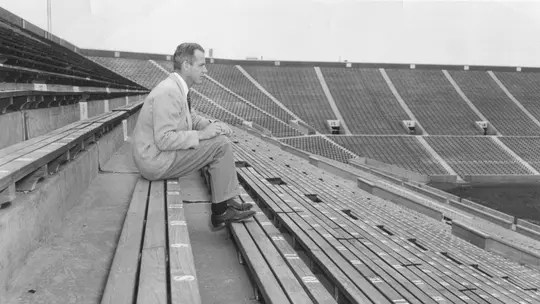
In the grandstands in those days was another Jay — Jay Wilkinson. The son of Bud Wilkinson was born in 1942 and was not yet of school age when his family moved to Norman in 1946. A year later, Bud became the Sooner head coach, and the early returns were so promising, a stadium expansion ensued.
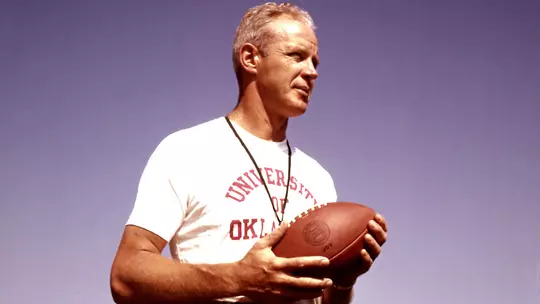
In 1949, Oklahoma Memorial Stadium was changed more profoundly than it’s ever been changed. Moreso than the 1975 addition of the westside upper deck and suites, or the 2003 addition of the eastside upper deck and suites, or even the 2016 bowling-in of the stadium.
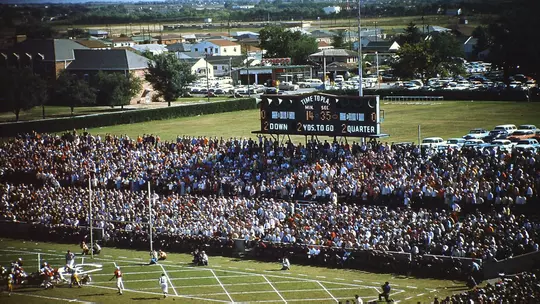
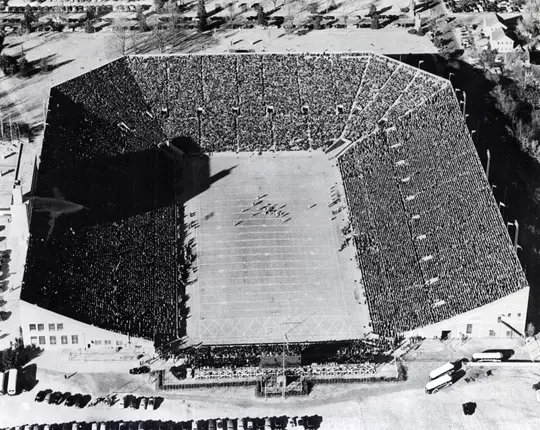
In 1949, the track circling Owen Field was removed, the field was lowered and about 10 rows of seats were added on both the east and west sides. Additionally, more than 16,000 seats were added with construction of the north-end seats, which created a horseshoe seating configuration.
“I thought that expansion was something,” said Jay Wilkinson, now 82 and living in Oklahoma City.
So did Bud Wilkinson.
“I think he felt proud coming down to Oklahoma, what he thought was a good tradition,” Jay Wilkinson said. “And because of the immediate success they had, with (predecessor) Jim Tatum recruiting, the expansion was a natural belief and conviction that this program was really going to continue to be outstanding and take advantage of the success.”
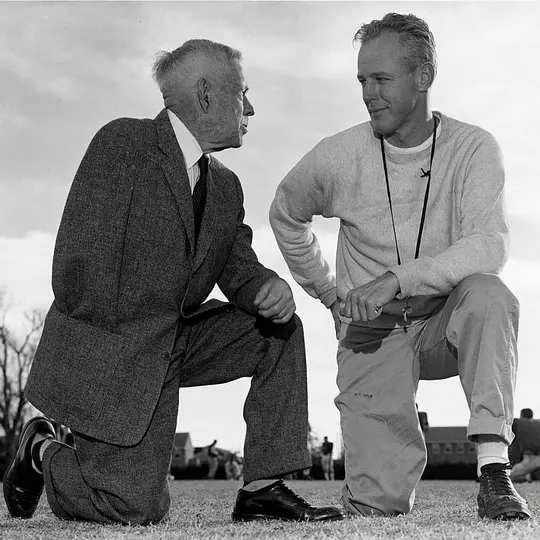
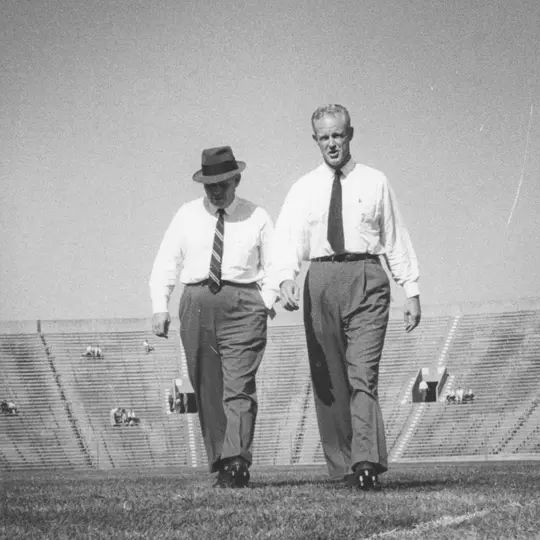
It was great football.
Bud Wilkinson believed the lowering of the field and bringing the seats nearer to the playing field gave the Sooners a greater homefield advantage. Three quarters of a century later, the narrow sideline space remains a calling card of Owen Field and figures to give OU an edge as the Southeastern Conference era begins.
“Almost all the schools had running tracks around the field,” Jay Wilkinson said. “A lot of really good stadiums had that running track around the football field. That was an advantage to bringing some of the fans closer to the field. Dad always felt it was. Tougher place to play whenever the fans were as close as they were.”
Over a 10-year period, from November 1947 through November 1957, Wilkinson’s teams went 46-1 on Owen Field. The loss was to Notre Dame, 28-21, on Sept. 26, 1953.
“It was big and large,” Jay Wilkinson said of the 1950s Memorial Stadium, which seated 55,647 from 1949 through 1956, then 61,724 after some small bleachers were added on the south end. “I think probably a lot of the teams that came into Norman felt it must have been an advantage to us, because those schools obviously had their own smaller stadiums. It had to be intimidating to athletes.”
The modern Oklahoma Memorial Stadium took shape in those days.
O’Neal, now 89 and vice president of Sooners Helping Sooners, an organization dedicated to assisting former OU athletes in a variety of ways, loves his Sooners and prefers the single-platoon version of football. He doesn’t get sentimental or emotional about the stadium.
“I’m too Old School,” he said. But man, does O’Neal remember the way it was seven decades ago.
On the south end of Owen Field, no seating or structures. It was all practice fields. Three in all, none of them 100 yards long. The farthest east field was for the freshmen. The farthest west shared the grass with baseball’s Haskell Park.
The dressing room was on the west side of the stands, which visiting teams to this day still use as their locker room. A surface parking lot lay just beyond the west gates.
O’Neal still can describe the wooden lockers with wire mesh. And the layout of the freshman locker room and the tiny coaches locker room, all sharing a communal shower. The equipment area, which was wedged under the incline of the stadium seats.
Which leads O’Neal to recall some of the people who made the stadium hum. Gatekeeper Morris Tenenbaum, who for decades passed out gum and kept a watchful eye for those who didn’t belong. Athletic trainer Ken Rawlinson, whose training room consisted of a hot tub and two tables for ankle taping.
Equipment manager Sarge Dempsey, a coarse Irishman who took a liking to O’Neal but not to many others. “Crusty as could be,” O’Neal said. Jack Baer followed Dempsey as equipment manager and “Baer learned from him,” O’Neal said. “Baer was the same way.”
Under the east-side stands was Pneumonia Downs, which served as an indoor track but was in reality bitter cold and dusty.
“The facilities, compared to today’s world, weren’t much, but at the time, we thought it was pretty damn good,” O’Neal said.
Jay O’Neal even lived in the stadium in summer 1954, sleeping on a mattress in the freshman wrestling room, which was just down the hall from the football locker room.
Jay Wilkinson never lived in the stadium. But though he never played for his dad — Jay went to Duke and became an All-America quarterback — Jay did play on Owen Field, and often, as a Norman High School star quarterback.
For fans who might remember high school games (or OU freshman games) on Owen Field, nothing is more striking than the lack of quality lighting.
“The lights were just horrible,” Wilkinson said. “Whenever we’d go play Enid or Chickasha or Lawton, you could see so much better, because the light was so much better.”
Other Jay Wilkinson stadium memories:
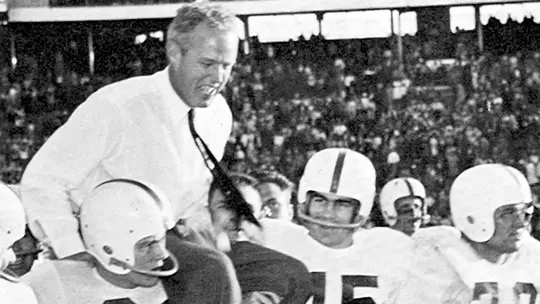
- His dad not leading the team onto Owen Field, but walking behind the Sooners as they traversed the ramp.
- The Pride of Oklahoma being a major part of games. “The band was so much a part of the history, I thought,” Jay Wilkinson said. “I just remember, they were so damn good, they executed so well. They were precision-oriented. I think they did more formations than they do today. They played great music. Oklahoma songs. They still bring a chill down to me.”
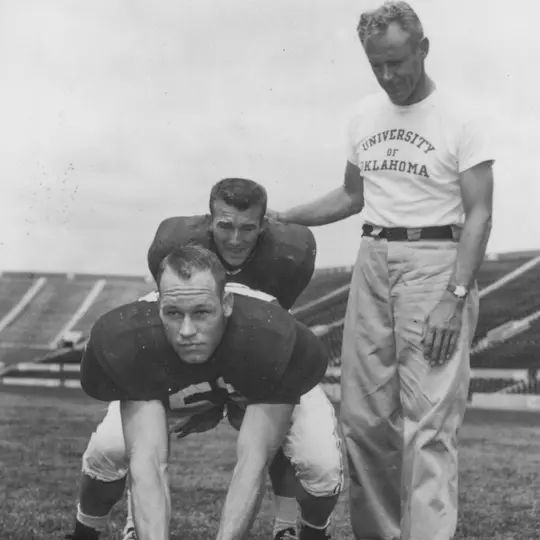
- Jay Wilkinson spending afternoons at OU practices, watching his dad drill those legendary Sooner teams.
“Certainly on game day itself, very emotional,” Jay Wilkinson said. “These were really fun days.
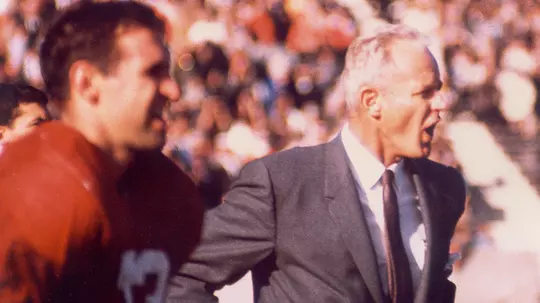
“But the times we were able to go to practice, it was sitting and listening, going from drill to drill. I do remember Bud hollering very positively to the players, after almost every play. The positive reinforcement.”
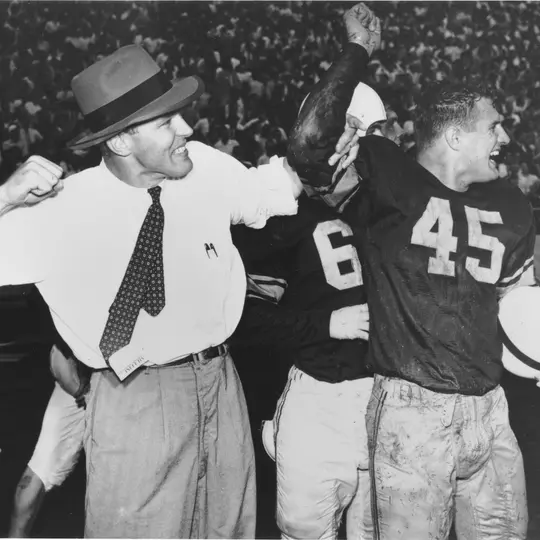
That positive reinforcement led to all those wins on Owen Field and the epic 47-game winning streak, which remains the sport's landmark achievement.
The 41-7 rout of ninth-ranked Missouri in 1948 that stamped the Sooners as perennial kings of the Big Seven.
A 28-21 survival of 19th-ranked Santa Clara in 1949 when quarterback Darrell Royal drove the Sooners out of the shadow of their goal line for a game-ending drive.
A 34-28 comeback over Texas A&M in 1950, on Leon Heath’s last-minute touchdown set up by Claude Arnold’s passing.
A stunning 27-20 win over Colorado in 1953 on Merrill Green’s 51-yard touchdown run with 36 seconds left in the game.
A 21-16 win over Texas Christian in 1954 when all-American linebacker Kurt Burris stopped the Horned Frogs’ Ronnie Clinkscale at the OU 7-yard line on the game’s final play.
But the most famous game of the Wilkinson era was a defeat. Notre Dame’s 7-0 victory over OU on November 16, 1957, remains one of college football’s most stunning upsets.
O’Neal, a graduate assistant coach in ‘57, remembers the stadium as a “morgue” that day.
Jay Wilkinson, a high-school sophomore, takes up the narrative.
“I remember the silence of just sitting there after the game,” Wilkinson said. “People seemed incomprehensible that it could not happen and would not happen.
“It was a gray, dreary day. Not to take anything away from Notre Dame, but I’ve had people like (OU halfback star) Clendon Thomas tell me, they just didn’t feel OU was quite physically ready to play. Which surprises me, because one of the great strengths of those teams was having the team prepared both mentally and physically.
“I remember it well. I remember the interception at the end of the game, when we were driving it down. It was just so unusual back in those days when they would lose.”
Wilkinson still recalls the response of OU public address announcer Jack Ogle.
“I remember him saying, ‘Let’s give them a big hand,’ probably after 30 seconds,” Wilkinson said. “I think a lot of people just sat in the stands for a long time, because they were surprised.”
Sixty-seven years later, Gaylord Family – Oklahoma Memorial Stadium looks a lot different. Upper decks and palatial locker rooms and training facilities that rival hospitals. State-of-the-art lighting and fabulous video boards and massive office complexes on both ends.
But the stadium memories of the two Jays and hundreds of thousands of Sooner fans remain vivid, and those tight confines, created in 1949, will come in handy more than ever as SEC opponents come to town.