Risinger’s Barbershop
Research and report by Bryce Jones (Ph.D. Candidate, U.S. History at the University of Oklahoma)
10/17/2024
This year marks the 100th in the history of Gaylord Family – Oklahoma Memorial Stadium, and OU Athletics is commemorating specific events that are tied to the OU football program, including the first discussions of football at the university in Norman. According to former longtime OU Athletics publicist Harold Keith, the first discussion of football at the Territorial University (later renamed the University of Oklahoma) occurred in September of 1895. In his book Oklahoma Kickoff, Keith states:
When the students brought out the old Spalding ball that [1895] autumn and began belting it about the premises, they discovered Jack Harts could kick it farther than anybody. And when they learned he had played the game at Winfield, his social stock soared even higher.
Let's get up a football team," Harts proposed at Risinger's barber shop one afternoon in September. His suggestion met with instant favor. The students had grown tired of just kicking the ball and yearned for a more vigorous expression of this fascinating new game that was sweeping the eastern colleges by storm. Harts was elected captain and coach and immediately began to assemble a team and organize a daily practice.
Oklahoma Kickoff: An Informal History of the First Twenty-Five Years of Football at the University of Oklahoma, and of the Amusing Hardships That Attended Its Pioneering. (by Harold Keith, Norman, OU Press, 1948), 7-8.
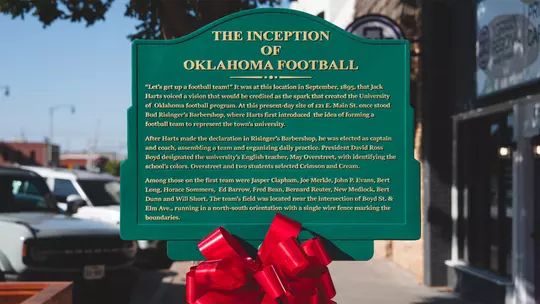
In order to commemorate the spot where OU football was envisioned, it is imperative to consider multiple types of evidence that can be used to identify the location of Risinger’s barbershop. This report uses articles and advertisements from the following newspapers: The Norman Transcript, The Norman Democrat, The Democrat, and The People’s Voice. Sanborn Fire Insurance maps offer spatial representations of specific streets and can be used to identify buildings/businesses mentioned in the newspaper articles and advertisements. This report will demonstrate that in the fall of 1895 Risinger’s barbershop was located at what is today 121 East Main Street, Norman, Oklahoma. The original timber framed structure where that discussion took place, however, was destroyed in 1896 and replaced by the brick building that currently resides at 121 East Main Street. Risinger relocated when the brick building was under construction, never occupying the new brick building at 121 East Main Street. He moved multiple times on the north and south side of the 100-block of East Main Street, but he finally settled in the brick building (constructed in 1914) at the current location 115 East Main Street.
Before Bud Risinger arrived in Norman, the barbershop he eventually bought was opened by Jim (James) Claire (Clare). Advertisements in Norman newspapers indicate the location of Claire’s barbershop, and a continuity in advertisements following Risinger’s ownership of the shop highly suggests that Risinger’s barber shop stayed in the same place throughout 1895.
On December 8, 1893, The Norman Transcript reported the established barber, Jim Claire, “moved his barber shop to the east side of the track Monday.” [1] In June 1894, Claire put out ads for his barbershop in different newspapers. The ad in The People’s Voice indicated the barber shop was “East Main Street,” while the ad in The Norman Transcript indicated the barber shop was “NEAR POST OFFICE.” [2] From these, Claire’s barbershop was on East Main Street near the post office. Claire’s was not the only barber shop on East Main Street, and the day before Claire’s ad in The Norman Transcript was published, H. Pellar, another barber, put an ad out in The Norman Democrat, which identified the location of his barbershop as “MAIN STREET OPPOSITE P.O.”[3] Based on these competing advertisements, the location of the post office itself is an important clue in determining the location of both Claire’s (later Risinger’s) barbershop, which was “NEAR” it, and the location of Pellar’s barbershop, which was “OPPOSITE” it.
[1] Friday, December 8, 1893, The Norman Transcript, page 5. [2] Saturday, June 9, 1894, The People’s Voice, page 8; Friday, June 22, 1894, The Norman Transcript, page 8. [3] Thursday, June 21, 1894, The Norman Democratic, page 8.
Besides these barber shop ads, there is a general absence of references to the post office in late 19th century Norman newspapers. Oklahoma Historical Society’s Encyclopedia of Oklahoma History and Culture’s entry for “Post Offices,” speaking generally about any given Oklahoma town, explains, “Typically, the first location of the post office was in a commercial building in the developing central business district, with the business proprietor acting as postmaster. For the first years, it was common for the post office to move around the maturing downtown, relocating in various brick buildings. Generally, the government did not undertake construction of substantial federal buildings in Oklahoma until after 1907 statehood.”[4] This explains the lack of overall mentions of the post office in early Norman newspapers. Despite a lack of evidence from the newspapers, other sources allow us to determine the location of the post office, Claire’s barber shop, and Pellar’s barbershop in 1894.
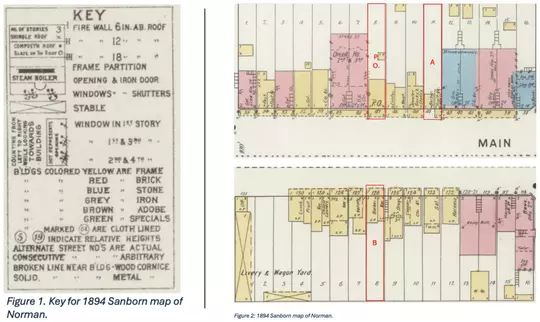
During the late-nineteenth century, fire was one of the biggest threats faced by businesses in the United States, and insurance companies had to take into consideration numerous variables when issuing fire insurance. As a result, the Sanborn Map Company would release maps used to create fire insurance policies based on the likelihood fire causing a loss to property. These maps were issued by city and visually relayed specific information about the structures (number of stories, type of roof, construction material, etc.) and the businesses that resided in them, which helped identify potential threats of fire. The key to the Sanborn map is used to translate information provided in the map itself. For example, buildings colored in yellow were (wood) frame, buildings colored in red were brick, and buildings colored in blue were stone. A combination of the colors indicated a mixture of those materials was used in the construction of the building. These maps were not created annually, but rather every other year or so, and after the turn of the century, new maps came out in 3–6-year intervals. For Norman, Oklahoma, there are Sanborn maps for the following years 1894, 1896, 1898, 1901, 1904, 1908, 1914, 1918.
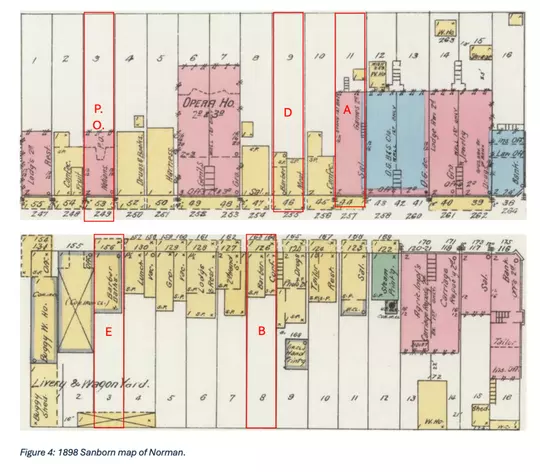
Sanborn Fire Insurance Maps corroborate information provided in newspaper advertisements as well as give a visual representation of the spatial data presented in those ads. For example, the 1894 Sanborn map identifies three barber shops on Main Street. Barber A: 44 Main, lot 11, north side. Barber B: 126 Main, lot 8, south side. Barber C: 32 Main, lot 4, north side (further east on Main Street and not pictured below). Also visible on the 1894 Sanborn map is the location of the post office at the time, which was 47 Main Street, lot 8, north side, just three lots away from Barber A, while on the other side of the street as Barber B. Based on this information provided in the 1894 Sanborn map, Barber A, located on lot 11 “NEAR” the post office on the north side of Main Street is where Claire’s barbershop was located; Barber B, located “OPPOSITE” the post office on the south side of Main Street is where Pellar’s barbershop was located. Barber C does not correspond with any of the references to the post office. According to its depiction in the Sanborn map, Claire’s barber shop was in a single story, wood frame building roughly 15ft by 20ft.
[4] “Post Offices,” Encyclopedia of Oklahoma History and Culture, Oklahoma Historical Society, https://www.okhistory.org/publications/enc/entry?entry=PO022.
With the knowledge that Claire’s barber shop was located on lot 11 on Main Street, newspaper evidence tracks the change in ownership but continuity in location of the barber shop from Claire to Risinger. In late December 1894, The Norman Democrat reported, “Jim Clare has sold his barber shop to a couple of gentlemen from Nebraska, who will take possession the first of the year.”[1] The following edition of The Norman Democrat included an article identifying the new owners as L. Eglehoff and C. H. Hathway, and in the same paper an ad stated “Eglehoff & Hathway (Successor to J. D. Clare).”[2] Somehow the sale to Eglehoff and Hathway fell through, and February editions of The Democrat and The Norman Democrat reported that “Wallace Parker has purchased a half interest in Jim Claire’s barbershop,” with an ad stating “O. K. Barbershop (Successor to J. D. Clare) W. O. Parker, Manager” before indicating it was located “North Side Main Street.”[3]
The Democrat reported on March 2, 1895, that “R. L. Risinger, of Anadarko, arrived in Norman this week, having purchased a half interest in the Star Barber Shop. The style of the firm is now Parker & Risinger.”[4] The same day, an ad in The People’s Voice stated, “Parker & Risinger…East Main Street.”[5] In March 1895, The Democrat advertised “The Star Barber Shop, Parker & Risinger, Props,” while The Norman Transcript ran an ad stating, “Parker & Risinger Barber…NEAR POST OFFICE.”[6]By April, Parker had left the barber shop, and The Democrat reported, “Risinger and Sparks can now be found at the Star Barber shop, Wallace Parker having quit the business,” while The Norman Democrat stated, “John L. Jones, the popular barber is now with the Lone Star barber shop…”[7] This was quickly reflected on advertisements, which mention “Risinger, Sparks & Jones” again indicating the location was “East Main Street” and “NEAR POST OFFICE.”[8] However, there was a change in the ad that The Norman Transcript was running, with the May 10th ad stating “NEAR POST OFFICE” and the May 17th ad stating “OPPOSITE POST OFFICE.”[9] From this, either the barber shop or the post office changed locations, and based on the previous information of early Oklahoma post offices, the change in the ads suggest the post office had moved to a new location that was now “opposite” the barber shop on the south side of Main Street. By June, Sparks had left the barber shop, and advertisements between June 1895 and October 1895 mention “Risinger & Jones” with the location still “North Side Main Street.”[10] There is a continuity of spatial references in the advertisements, even as ownership continued to change. They continually reference being on the north side of East Main Street. This is the location of Risinger’s barber shop when the first discussion of collegiate football took place in Norman: 44 Main Street, lot 11 (the street numbers would eventually change, but the lot numbers stay consistent throughout the Sanborn maps). The same ad stating “Risinger & Jones Barbers OPPOSITE POST OFFICE” ran until early 1896 in The Norman Transcript.
[1] Friday, December 28, 1894, The Norman Democrat, page 5. [2] Friday, January 4, 1895, The Norman Democrat, page 4, 5. [3] Saturday, February 2, 1895, The Democrat, page 3; Friday, February 15, 1895, The Norman Democrat, page 2. [4] Saturday, March 2, 1895, The Democrat, page 3. [5] Saturday, March 2, 1895, The People’s Voice, page 4. [6] Wednesday, March 6, 1895. The Democrat, page 2; Friday, March 8, 1895, The Norman Transcript, page 4. [7] Wednesday, April 10, 1895, The Democrat, page 3; Friday, April 12, 1895, The Norman Democrat, page 3. [8] Friday, May 3, 1895, The People’s Voice, page 4; Friday, May 3, 1895, The Norman Transcript, page 8. [9] Friday, May 10, 1895, The Norman Transcript, page 8; Friday, May 17, 1895, The Norman Transcript, page 1. [10] Friday, June 7, 1895, The Norman Democrat, page 1; Friday, October 4, 1895, The Norman Democrat, page 3.
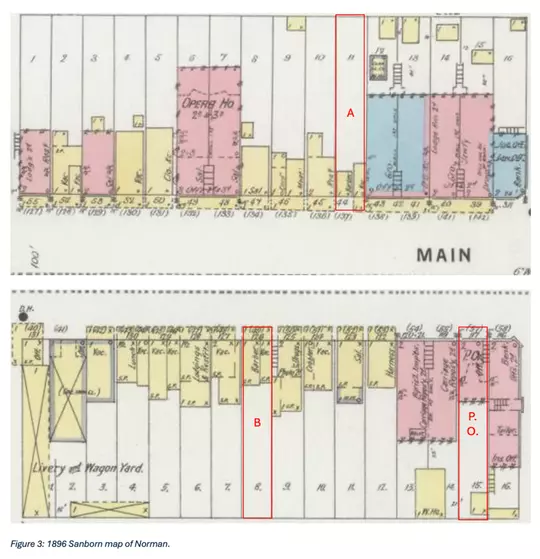
The 1896 Sanborn map of Norman helps address the changes mentioned in the previous newspapers. By 1896, Barber A, identified in the 1894 map as Claire’s, is still in the same location of 44 Main, lot 11, north side; and Barber B, identified in the 1894 map as Pellar’s, is still in the same location 126 Main, lot 8, south side. The post office no longer appears on the north side of Main Street west of Barber A, but has moved to the 117 Main, lot 15, south side. This movement corresponds with the change from “NEAR POST OFFICE” to “OPPOSITE POST OFFICE” of the Risinger & Jones ads ran in The Norman Transcript in 1895, as the new post office location was on the opposite side of Main Street as Barber A in the 1896 Sanborn maps.
By July 1896, the original single-story, frame structure that housed Risinger’s barber shop was destroyed. The July 17th edition of The Norman Democrat stated “Bud Risinger has moved his barber shop on the opposite side of the street from his former place of business,” meaning he had relocated to the south side of Main Street, and shortly beneath that it stated “Mr. Payton will erect a two story stone building 25x60 on the north side of East Main street.”[1] The new, 2-story building was completed in October 1896, and the October 9th edition of The Norman Democrat reported, “Frank Smith moved his saloon into the new building of Mr. Payton’s this week.”[2] There is a lack of ads for Risinger’s barber shop in 1897. While there is no report that he had again moved his barber shop for a second time in the past year, The Democrat reported in February 1897 that “The city is laying another pipe across Main St. this week, taking the water to R. L. Risinger’s new barber shop.”[3] The reference to “Risinger’s new barbershop” could mean the location opposite his original spot or a more recent, unreported, move. However, in March 1898, The Norman Transcript ran an ad stating, “R. L. Risinger Barbers OPPOSITE POST OFFICE.”[4] If Risinger had moved opposite his old shop, he’d be on the south side of Main Street, and the post office would need to be on the north side in order to be opposite it, as stated in the 1898 ad.
The 1898 Sanborn maps again address some of the changes and continuities mentioned in the newspapers. A two-story brick building is identified at 44 Main, lot 11, north side, where Risinger’s original barber shop was located. This was the building Payton had constructed and is still standing in the same location. This map shows the building was occupied by a saloon, corresponding with the The Norman Democrat report that Smith’s saloon occupied the new building. The post office moved again, this time it was at 53 Main, lot 3, north side. There is a new barber shop (Barber D) located at 46 Main, lot 10, northside, which is two lots west of Risinger’s original barber shop. Barber B is still at 126 Main, lot 8, south side, but another new barber (Barber E) located at 156 Main, lot 3, south side. Barber E is labeled “Barber Baths” on the map, which could reference the water pipes that reportedly went to Risinger’s new shop. Additionally, Barber E is located on lot 3 of the south side of Main Street and the post office was located on lot 3 of the north side, opposite each other, corresponding to the 1898 ad that Risinger’s was “OPPOSITE POST OFFICE.” Barber E was likely Risinger’s 1898 location.
[1] Friday, July 17, 1896, The Norman Democrat, page 8. [2] Friday, October 9, 1896, The Norman Democrat, page 8. [3] Thursday, February 18, 1897, The Democrat, page 5. [4] Friday, March 25, 1898, The Norman Transcript, page 1.
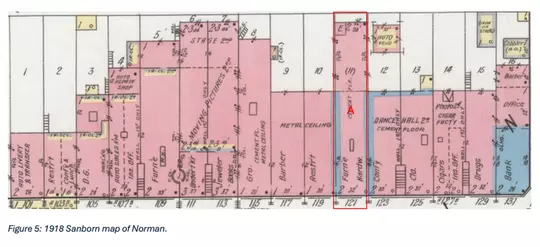
Advertisements for Risinger’s barber shop come to a halt in 1899, but papers do report Risinger making improvements to his shop. Again, it is not clear if this shop is located on the south side or north side of main street. At some point prior to the 1902 fire, Risinger must have moved back to the north side of Main Street, as newspapers do not mention his barber shop being destroyed or taking damage from the fire that occurred on the south side of Main Street. Risinger likely bought one or more lots on north Main Street, and may have moved is barber shop around during this period, as ads mention other businesses in the “Risinger Building.”[1] As early as 1909, Risinger planned to demolition the wood frame building(s) on his lot(s) on north Main Street, and in 1914 the single-story brick buildings that currently occupy 115, 117, and 119 East Main Street were constructed.[2] Risinger moved his barber, then called Sooner Barber, into the new brick building at 115 East Main Street in 1914.[3] This was likely the location of Risinger’s shop until he sold his business in 1916.[4] The 1918 Sanborn map shows the north side of Main Street with updated addresses, which gives the address for lot 11 (where Claire then Risinger’s barber shop was located) as 121 East Main Street.
[1] Thursday, April 11, 1901, The Norman Transcript, page 5. [2] Thursday, August 19, 1909, The Norman Transcript, page 1; Thursday, September 17, 1914, The Norman Transcript, page 5. [3] Thursday, December 31, 1914, The Norman Transcript, page 1, 7. [4] Thursday, November 2, 1916, The Norman Transcript, page 7.