

University of Oklahoma Athletics
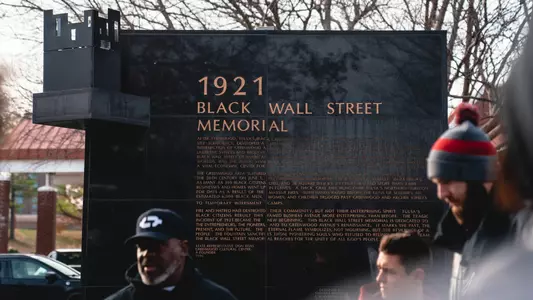
Remembering the Impact of Greenwood; Sooners Visit Oklahoma Historical Site
May 31, 2023 | Athletics
On May 31, 1921, in a span of approximately 18 hours, the Black Wall Street business corridor in the Greenwood District of Tulsa was savagely decimated by white rioters in what is now referred to as the Tulsa Race Massacre. Historians estimate 300 people were killed, more than 800 wounded, 1,256 homes were destroyed, 35 city blocks lay in ruins and 191 business locations were burned down, in addition to churches, schools, a hospital and a library. The American Journal of Economics and Sociology reported the massacre reduced local Black wealth by more than $200 million in current dollars.
One of those destroyed businesses was Uncle Steve's, a popular barbecue joint owned by the great grandfather of Oklahoma assistant men's basketball coach Ryan Humphrey. Uncle Steve's was the place to go for BBQ. Imagine the popularity of Oklahoma Joe's today, but a century earlier.
"You never know, it could have become one of those franchises like a McDonald's," Humphrey said. "It could have brought generational wealth, not just for my great grandfather but there were other families also affected (by the massacre)."
The day before the OU men's basketball team played Arkansas in a neutral site game at the BOK Center this past Dec. 10, the entire Sooners travel party walked the streets of the Greenwood District in an educational and undeniably emotional field trip.
The venture was organized by Humphrey, a former McDonald's All-American at Booker T. Washington High School in Tulsa, who signed with the Sooners prior to the 1997-98 season. He joined coach Porter Moser's staff on July 1, 2022, after spending six seasons at Notre Dame as an assistant under coach Mike Brey and served as an assistant at Northwestern for two seasons.
"An OU alum I went to school with at Booker T. came and watched practice, and from there the idea kind a grew legs," Humphrey said of how the field trip originated. "I thought it would be a great trip and great experience for our guys. My connection to the Greenwood District runs very deep."
Most current players – particularly those from out of state – knew little about the Tulsa Massacre. So learning was the trip's primary purpose.
"It was all about educating," Humphrey said. "With our guys, it's sad to say, but it's true. My background is different because I grew up there and knew a lot of the history. This is Oklahoma history, but it's also world history. Being in the state of Oklahoma, I think it was enlightening for everybody. In our travel party, we've got freshmen who didn't know what Bedlam is. What is the Trail of Tears? What was the Black Wall Street? What is Langston, plus other Black towns throughout the state of Oklahoma?"
"I had no idea about the Tulsa Race (Massacre)," said senior forward/center Tanner Groves, who transferred to OU after playing three seasons at Eastern Washington. "I never learned it in school really, so it was incredibly eye-opening to learn what happened in the city. If you really think about it, it's not that far removed in history. It's just crazy to see the state of America, what it used to be like and how far we've come, but how far we still have to go. It was just an incredible experience getting to learn about that. It was really humbling.
"I wasn't ignorant to the fact, but I didn't really know about Black Wall Street. Getting to visit that historical site was just really incredible and eye-opening to see the impact that Black culture had in the city. It was really impressive."
Freshman guard Otega Oweh hails from Somerset. N.J., and admitted he was unaware of the Tulsa Massacre.
"Going there and being able to learn this type of information, this type of history, was big for me," Oweh said. "I think it was big for the whole team because we got to see what a lot of these people had to go through. Even how the town looks now, it looks completely different, and how they just continued to try to build and restore that. So it was really a good moment being able to see that kind of history."
Sports offer team diversity, which is why OU's field trip had a universal impact.
"Getting to play the sport of basketball, I've played with so many different races and ethnicities," Groves said. "It's just kind of cool to experience that and it's kind of fun. It's just the way I was raised; doesn't matter what the color of your skin is. Everyone bleeds the same color. I'm blessed to have the experience to play basketball and get to interact with a wide variety of people. It's just really cool and the sport of basketball has helped shape who I am."
Oweh added, "Just being able to see the certain expressions on my teammates' faces, it was huge and I know it really touched them to be able to learn that kind of history as well."
Exposure surrounding the massacre's 100th anniversary two years ago has spawned significant interest in the tragedy nationwide. Representations of what transpired have never been more thorough or more graphic. However, Humphrey said there's still more research to be done, more information to be shared.
"It's amazing that now it's starting to gain legs and the history is getting out, but history can be diluted," said Humphrey, who starred for two seasons at OU before transferring to Notre Dame where he was a second-team All-American as a senior. "I don't think everything we showed our guys, everything we've seen and all the research really does it justice. It's hard to detail and show what really happened because none of us was there. I just talked to my aunt Mildrew Howell. She's 90-something years old. She said, 'You know, some of the stuff wasn't talked about. Imagine going through something like this, your family just pressing through and not really having conversations about it because of the horror and the pain they went through.'"
The men's basketball team wasn't the first OU group to visit the site of the Tulsa Massacre. In the summer of 2021, the university's football team ventured to Greenwood on a trip organized in part by Vice President for Student Affairs and Dean of Students Dr. David Surratt.
A travel party of 60-70 players made its way to Tulsa in two buses. Players walked up and down Black Wall Street and visited the newly opened Greenwood Rising history museum and memorial.
"They did a really good job with the museum," said former OU linebacker Caleb Kelly, who is now a director of the football program's SOUL Mission player development program.
"There was a lot of interaction. They had artifacts there. There was information you would want to know. There was art everywhere – Black art. That was a cool experience. We had a sit-down and someone answered a bunch of questions. 'What can we do?' 'How can we help?' Things like that."
Kelly said he was particularly impressed with the museum's tactful presentation.
"They were trying to spread light on the positives but still talked about the negatives in what I thought was an appropriate way," Kelly said. "I remember a couple of players getting emotional, almost crying. It's crazy how much pain people go through – being Black ourselves – with how much is going on. It was definitely an emotional place. It got graphic in some parts. They had all the news clippings and everything. It's emotional, but it's real and enlightening."
The emphasis of the trip was not about race, Kelly said.
"It was a team thing," Kelly said. "We didn't make it about white and Black, but that's the culture of football teams. There are whites, there are Blacks, there are others sprinkled in. You get used to talking about different things, things that pop up. It was real welcoming for a lot of white guys who kind of shared their piece, too. When we opened up with the founders of the museum, a lot of guys spoke up trying to get different information. 'What can I say?' 'What can't I say.' 'What can I do with my guys to help in their grief?' 'How can I make a change?' It was pretty powerful."
The bus ride back to Norman revealed the impact of the day's venture.
"There wasn't a lot of joking around on the trip back home," Kelly said. "It wasn't a laughing matter. It was a real serious trip."
Serious, indeed. Also illuminating and impactful.
One of those destroyed businesses was Uncle Steve's, a popular barbecue joint owned by the great grandfather of Oklahoma assistant men's basketball coach Ryan Humphrey. Uncle Steve's was the place to go for BBQ. Imagine the popularity of Oklahoma Joe's today, but a century earlier.
"You never know, it could have become one of those franchises like a McDonald's," Humphrey said. "It could have brought generational wealth, not just for my great grandfather but there were other families also affected (by the massacre)."
The day before the OU men's basketball team played Arkansas in a neutral site game at the BOK Center this past Dec. 10, the entire Sooners travel party walked the streets of the Greenwood District in an educational and undeniably emotional field trip.
The venture was organized by Humphrey, a former McDonald's All-American at Booker T. Washington High School in Tulsa, who signed with the Sooners prior to the 1997-98 season. He joined coach Porter Moser's staff on July 1, 2022, after spending six seasons at Notre Dame as an assistant under coach Mike Brey and served as an assistant at Northwestern for two seasons.
"An OU alum I went to school with at Booker T. came and watched practice, and from there the idea kind a grew legs," Humphrey said of how the field trip originated. "I thought it would be a great trip and great experience for our guys. My connection to the Greenwood District runs very deep."
Most current players – particularly those from out of state – knew little about the Tulsa Massacre. So learning was the trip's primary purpose.
"It was all about educating," Humphrey said. "With our guys, it's sad to say, but it's true. My background is different because I grew up there and knew a lot of the history. This is Oklahoma history, but it's also world history. Being in the state of Oklahoma, I think it was enlightening for everybody. In our travel party, we've got freshmen who didn't know what Bedlam is. What is the Trail of Tears? What was the Black Wall Street? What is Langston, plus other Black towns throughout the state of Oklahoma?"
"I had no idea about the Tulsa Race (Massacre)," said senior forward/center Tanner Groves, who transferred to OU after playing three seasons at Eastern Washington. "I never learned it in school really, so it was incredibly eye-opening to learn what happened in the city. If you really think about it, it's not that far removed in history. It's just crazy to see the state of America, what it used to be like and how far we've come, but how far we still have to go. It was just an incredible experience getting to learn about that. It was really humbling.
"I wasn't ignorant to the fact, but I didn't really know about Black Wall Street. Getting to visit that historical site was just really incredible and eye-opening to see the impact that Black culture had in the city. It was really impressive."
Freshman guard Otega Oweh hails from Somerset. N.J., and admitted he was unaware of the Tulsa Massacre.
"Going there and being able to learn this type of information, this type of history, was big for me," Oweh said. "I think it was big for the whole team because we got to see what a lot of these people had to go through. Even how the town looks now, it looks completely different, and how they just continued to try to build and restore that. So it was really a good moment being able to see that kind of history."
Sports offer team diversity, which is why OU's field trip had a universal impact.
"Getting to play the sport of basketball, I've played with so many different races and ethnicities," Groves said. "It's just kind of cool to experience that and it's kind of fun. It's just the way I was raised; doesn't matter what the color of your skin is. Everyone bleeds the same color. I'm blessed to have the experience to play basketball and get to interact with a wide variety of people. It's just really cool and the sport of basketball has helped shape who I am."
Oweh added, "Just being able to see the certain expressions on my teammates' faces, it was huge and I know it really touched them to be able to learn that kind of history as well."
Exposure surrounding the massacre's 100th anniversary two years ago has spawned significant interest in the tragedy nationwide. Representations of what transpired have never been more thorough or more graphic. However, Humphrey said there's still more research to be done, more information to be shared.
"It's amazing that now it's starting to gain legs and the history is getting out, but history can be diluted," said Humphrey, who starred for two seasons at OU before transferring to Notre Dame where he was a second-team All-American as a senior. "I don't think everything we showed our guys, everything we've seen and all the research really does it justice. It's hard to detail and show what really happened because none of us was there. I just talked to my aunt Mildrew Howell. She's 90-something years old. She said, 'You know, some of the stuff wasn't talked about. Imagine going through something like this, your family just pressing through and not really having conversations about it because of the horror and the pain they went through.'"
The men's basketball team wasn't the first OU group to visit the site of the Tulsa Massacre. In the summer of 2021, the university's football team ventured to Greenwood on a trip organized in part by Vice President for Student Affairs and Dean of Students Dr. David Surratt.
A travel party of 60-70 players made its way to Tulsa in two buses. Players walked up and down Black Wall Street and visited the newly opened Greenwood Rising history museum and memorial.
"They did a really good job with the museum," said former OU linebacker Caleb Kelly, who is now a director of the football program's SOUL Mission player development program.
"There was a lot of interaction. They had artifacts there. There was information you would want to know. There was art everywhere – Black art. That was a cool experience. We had a sit-down and someone answered a bunch of questions. 'What can we do?' 'How can we help?' Things like that."
Kelly said he was particularly impressed with the museum's tactful presentation.
"They were trying to spread light on the positives but still talked about the negatives in what I thought was an appropriate way," Kelly said. "I remember a couple of players getting emotional, almost crying. It's crazy how much pain people go through – being Black ourselves – with how much is going on. It was definitely an emotional place. It got graphic in some parts. They had all the news clippings and everything. It's emotional, but it's real and enlightening."
The emphasis of the trip was not about race, Kelly said.
"It was a team thing," Kelly said. "We didn't make it about white and Black, but that's the culture of football teams. There are whites, there are Blacks, there are others sprinkled in. You get used to talking about different things, things that pop up. It was real welcoming for a lot of white guys who kind of shared their piece, too. When we opened up with the founders of the museum, a lot of guys spoke up trying to get different information. 'What can I say?' 'What can't I say.' 'What can I do with my guys to help in their grief?' 'How can I make a change?' It was pretty powerful."
The bus ride back to Norman revealed the impact of the day's venture.
"There wasn't a lot of joking around on the trip back home," Kelly said. "It wasn't a laughing matter. It was a real serious trip."
Serious, indeed. Also illuminating and impactful.
Tuesday, June 09
Monday, April 13
Monday, April 13
Monday, April 06


