University of Oklahoma Athletics
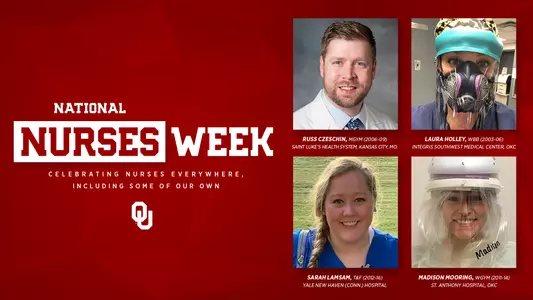
National Nurses Week with Some of Our Own
May 06, 2020 | Athletics
Sarah Lamsam, Laura Holley, Russ Czeschin and Madison Mooring previously experienced the stress of being University of Oklahoma student-athletes. During the last two months, their levels of stress have become immeasurable.
Wednesday is National Nurses Day. In the throes of COVID-19, never has the profession carried a heavier burden than right now, and these former Sooners all serve as nurses.
Lamsam (then Sarah Tolson) was a school-record weight thrower for the OU track and field team from 2012-16. She now serves as a registered nurse in the Emergency Department at Yale New Haven (Conn.) Hospital.
When dealing with a pandemic, there is tragedy in numbers. The denser the population, the more tragic the circumstances, which explains why New York, New Jersey, Massachusetts, Pennsylvania and Connecticut accounted for more than 49 percent of all confirmed COVID-19 cases and more than 52 percent of all deaths nationally as of Tuesday afternoon. (Oklahoma ranked 36th nationally in the number of confirmed cases.)
Much like the World Trade Center on 9/11, greater New York City has become Ground Zero.
Lamsam works approximately 80 miles northeast of NYC. Circumstances have been so dire, patients occasionally have been transported by ambulance from New York to New Haven.
"Their hospitals are full, so some will get in their car and drive to Connecticut to be seen at Yale," Lamsam said. "We weren't as impacted as heavily as New York, but we were definitely prepared for it if it did happen. I mean, it was bad."
Tolson graduated from nursing school in March of 2018. Her husband, Layton Lamsam, completed his undergraduate and medical degrees from Stanford and is serving a seven-year residency in the Department of Neurosurgery at the Yale University School of Medicine. The couple was married in April of 2019 and moved to Connecticut last June.
The plan of attack at Yale is to presume the worst in each patient.
"We are told to treat every patient as if they're COVID positive," Sarah Lamsam said. "That's obviously not going to be the case because you're still going to have people who are coming because they're having a heart attack or they got in a car accident, and it's not because they have COVID. But we're told you treat every patient like they're COVID positive because you just don't know. There are so many people who are asymptomatic. My husband and I, we brought his grandparents and his mom to Connecticut with us. So we're a three-generational home. My husband and I are in and out of the hospital, so we're having to distance ourselves because we could be asymptomatic and bring it home and not know. It's changing our lives at the hospital and also our home life."
Lamsam said Yale is armed with the necessary PPE (Personal Protective Equipment). "We're a Level One trauma center," Lamsam explained. "The sickest of the sick in Connecticut come to us and in the whole area, too."

Russ Czeschin

Laura Holley

Sarah Lamsam

Madison Mooring
Holley, then Laura Andrews, played on the OU women's basketball team from 2003-06. She is an RN Team Manager of the Cardiac Cath Lab for INTEGRIS Southwest Medical Center in Oklahoma City.
Prior to the coronavirus, Holley dealt with cardiac patients and had Intensive Care Unit (ICU) background for three years before working in the Cath Lab. She has been with INTEGRIS seven years total.
"When all of this started happening. we had to formulate a plan for if we ever have a surge and how could we send help to our ICUs," Holley explained. "We went up and trained in the ICU directly with the COVID patients. You're ready and waiting for when and if they need us. Some of our nurses are over in the Emergency Room every day. We're kind of on a rotation of whoever needs us in the ICU and ER."
Two of Holley's biggest supporters since COVID-19 arrived have been Sooners head coach Sherri Coale and former longtime assistant Jan Ross, who is now the basketball program's chief of staff. "Coach Coale and coach Ross have both checked on me and that meant more than anything, just telling me how proud they were of me," Holley said.
Czeschin was a three-time All-American on floor exercise and a one-time All-American on vault as a gymnast from 2006-09. A former second-team Academic All-American, he received OU's 2009 Outstanding Sooner Scholar-Athlete Award, given to a student-athlete with the best academic and athletic performance. He is now a Family Nurse Practitioner working in primary care for Saint Luke's Health System in Kansas City, Mo.
Asked how his workload has changed since the arrival of the coronavirus, Czeschin said, "Right now, I'm really trying to focus on the day-to-day goals to make the ending goal of hopefully getting through this pandemic safely and doing as much as I can for the community to decrease the strain... It's just continuing our day-to-day stuff with the addition of the additional stress of something that's kind of new, a novel virus, and trying to take it one day at a time and not trying to get too worked up into making myself a little overwhelmed with everything."
Mooring was a two-time first-team All-American on vault and a second-team All-American on beam as an OU gymnast from 2011-14. She now serves as an RN in the Critical Care Unit at St. Anthony Hospital in Oklahoma City.
"The beginning was a little bit emotional, but we're starting to find our groove," Mooring said of battling the virus. "We're just all working together, so that's helped a lot."

Maria Jackson

Callie Parsons

Caitlin Paul

Brie Tillman

Carrie Whigham

Treva Whitaker
COVID-19 has added immeasurable stress to people's lives, even more so with healthcare workers. How they're able to handle that stress is key. All four Sooner said they benefitted from their athletic experiences at OU.
Holley: "It's funny because different times in your life you feel different levels of stress, and in the moment those feel like the biggest thing that you'll ever have to feel. Playing basketball at OU and just feeling that type of stress as an 18-year-old kid, managing basketball, academics, friends and learning to live on your own and everything, I think the coaches did a great job of preparing us to try to roll with the punches as best you can and know that better days are coming."
Lamsam: "I feel I'm pretty good at handling stress. I really do attribute that to my sports career. Because like in athletics, you're kind of stressed out at a track meet or when you're competing. That's helped out a lot. That's why I like the emergency department because it's a highly stressful job."
"Who would've thought we would have been working through a pandemic? That never even really crossed my mind."
- Sarah Lamsam
Czeschin: "I attribute a lot of my success to my athletic background, especially with gymnastics. I was 6-foot-3. I was the tallest gymnast in college. I'm not a normal person for gymnastics, by any means. And I think that took a lot of determination to focus on what the goals are. Sometimes those goals were day-to-day. Sometimes those goals were year-long goals. The combination of those two I think has been helpful with my history in gymnastics and the day-to-day stuff as well as the weekly, the monthly and yearly goals. There's always an overlap with all of those qualities that you learn, especially in gymnastics, and as a collegiate athlete. I think that has helped really try to keep my blinders on and focused on the goal."
Mooring said she works out to help her decompress, while Holley turns to her 5-year-old daughter, Kobi.
"The thing that has probably brought me the most joy out of this is we try to take every day we can, even if it's in the evenings, and we sit outside and do sidewalk chalk," Holley said with a chuckle. "To be outside in the quiet, in the sun, and just be with her. That's the biggest thing I can do to decompress."
Czeschin heads outside whenever possible. "Especially when it's nice out, get some sun and trying to evaluate life in general and the things that are important and trying to keep myself busy with working in the garden and walking my dog and doing as much as I can to keep my mind active and not allow myself to kind of go down a spiral," Czeschin said. "It would be easy to go kind of into a darker place of concern, not necessarily terror, but concern and being scared about all these issues."
Those who enter the medical field are aware of the challenges that await, but how many signed up anticipating an influenza pandemic?
Lamsam: "A lot of my coworkers and I have talked about how we signed up to take care of people, especially in the emergency department. You're taking care of people who are hyperacute and you've got to work on them really fast to get them feeling better, but who would've thought we would have been working through a pandemic? That never even really crossed my mind. I think I always knew there was going to be another pandemic again someday because of the way scientists and immunologists and biologists, they're talking about the Spanish flu in 1918 that we're going to have something similar, but I never thought I would be working through it treating one."
"This is what we were called to do. This is what we're supposed to do is take care of our patients... So to see people show that gratitude, that means more than anything to me."
- Laura Holley
Holley: "These past couple of weeks have been better because we're further into it. We know to expect the unknown now. We feel more calm. We have everything we need now. We have respirators. We have N95 masks. We have face shields. I think the further removed from the beginning of this, it's kind of become our new 'comfort zone,' if you will. In the beginning, it was just a mess. (We were) terrified, anxious. I'm one of the leaders in our cath lab, so I'm a fixer. I like to give people clear answers and make everyone feel comfortable and make sure that they feel OK, safe and protected. I couldn't do that in the beginning because I didn't have answers. Things were changing every day. I was nervous and anxious as well, so I think that's where a lot of my stress came from. I couldn't do anything to fix this."
Czeschin: "Unfortunately, the coronavirus isn't something that is discriminating the old, young, healthy, not healthy. It's hit and miss. Honestly, it's very odd the way it's attacking the population."
The biggest fear, for healthcare workers and patients alike, has been the fear of the unknown.
"Within healthcare, usually it's strict rules. They're never broken. You have strong, set guidelines," Holley said. "With this, it's just been so unknown every single day. When we have meetings, things are changed. Just trying to keep up with that and relaying those things to our staff and trying to remain calm, but then at the same time I felt not calm because everything is just different. You just have to try to figure out how to keep a level head through it all."
Testing for the virus has been a point of contention since the outset. When tests were available, results would often take a week or longer, but not now. "We have the rapid tests now," Mooring said, "so we know pretty quickly, within about 45 minutes to an hour."
"We can't physically lean on each other right now, but we can emotionally be there for each other and support each other through this."
- Russ Czeschin
Lamsam has been working the front lines, but Mooring also has been in a New York state of mind quite frequently.
"It's pretty emotional," Mooring said. "I have a couple of friends there right now and they confirm it is pretty intense. So many of these patients are incredibly sick and so many of them and the (healthcare) workers are lacking PPE."
Holley marvels at the healthcare workers in hot spots like NYC and also at the support they receive from the general public.
"The videos that give me chills are how proud the people of New York are of those healthcare workers," Holley said. "They line the streets every day. They yell for them. The fire trucks are out there. Just to see a sense of community and trust that they have in the healthcare workers and showing them their gratitude."
Earlier this week, there was a flyover of support for healthcare workers in the OKC metro area. A hug from the sky.
"I just think that's the coolest thing, that they would be willing to do something like that for us," Holley said. "It gives me chills. This is what we were called to do. This is what we're supposed to do is take care of our patients. I think most healthcare workers have that compassion for their patients and would do anything for them. So to see people show that gratitude, that means more than anything to me."
Would OU's healthcare workers like to relay any messages to Sooner fans about what the future holds?
Lamsam: "The good news is we're learning new information every day. We're learning more about this virus, like how it's spreading, how many days you're sick for, stuff like that. But people just need to be aware that you've got to be smart about this stuff, like washing your hands and distancing yourself. It's just miserable, but we will recover. That's what we keep saying. 'It's all going to go back to somewhat of a normal.'"
Czeschin: "Sooner fans are very tough and very enthusiastic and they are going to stand by each other no matter what. I think it's very important to have that sense of community, especially in this time. We can't physically lean on each other right now, but we can emotionally be there for each other and support each other through this."
Holley: "I want everyone to know that (an) end will come (to) this. I believe calm will come, a sense of normalcy will come back. I hope that everyone can stay strong."
One final plea from Lamsam: "Be safe back home. My parents, who are back in Oklahoma, I tell them, 'Continue to distance yourselves and be safe because this thing is serious.' I just cringe every time I see people out who are close together. I'm like, 'Noooo.'"