University of Oklahoma Athletics
Black History Month: Kur Kuath
February 20, 2020 | Athletics, Men's Basketball
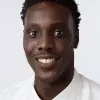
It's hard for Kur Kuath to hide the constant smile on his face.
With a tall, 6-10 frame, it's hard to hide much of anything.
A junior forward on the Oklahoma men's basketball team, Kuath bears a contagious smile that lights up the gym after a vigorous alley-oop and stands out in the classroom, even when taking an exam.
Kuath's signature smile is a physical symbol representing the abundance of gratitude in his life. Given the journey he's been through in his life, he has a lot to be grateful for.
Grateful to have a home after living through war and homelessness.
Grateful for parents who risked everything they had for him to have a better life.
Grateful for a brother who showed him how to overcome adversity.
Grateful for a coach who saw his potential and pushed him to the next level.
Grateful for a college education while playing the sport he loves.

Born in Khartoum, Sudan, Kuath (pronounced "Kweth") was born in the midst of a violent civil war. His family had arrived in Khartoum to flee uprising violence in their home of Biemnom, Sudan – which has since split into South Sudan.
As the dangers of the civil war continued to spread throughout the country, Kuath's family left their home to seek peace and safety. They fled north to the neighboring country of Egypt.
"When we first got to Egypt, we were homeless for the first five, six months and looking for somewhere to live," recalls Kuath. "It was a more racial time towards our country just because of all the bad things that were happening. It was hard to find living."
Still a young toddler at the time, Kuath and his family spent those first few months sleeping in shelters and churches while his parents sought work. Eventually, their persistence paid off and his mother found a job that helped them afford a place to live.
The home was small with two bedrooms and accommodated both Kuath's direct and extended families. He recalls between 15 and 20 people cramming into the two rooms.
While living in the small two-bedroom house, Kuath's parents sought more permanent safety through the United States government. At 3 years old, Kuath and his family were granted refugee status and residence in the Salt Lake City area.
"They moved us to Salt Lake because that's where that's where missionaries offered to help us," said Kuath. "They helped my parents figure out the whole American system because they moved to America with no education, no job, no money. They had no clue and understanding how the whole system worked."
"I hope people take motivation and understanding of how hard it is trying to come into this country and really start from nothing."
- Kur Kuath
Living in his third country in three years and still a young boy, Kuath vividly remembers the dedicated work ethic his parents showed during their formative years in the United States.
"They had to learn English and learn how to do taxes, travel, how to get to work, how to pay bills," said Kuath. "It was a learning experience growing up, especially because my parents really didn't have too much knowledge of how it works in America. They were great influences to me and my siblings and taught us that you could do anything. Even though they left everything back home… My parents just gave up a lot for me and my siblings to be able to fulfill our dreams. I'm truly thankful for them every day."
Kuath, who predominantly spoke the Dinka language and some Arabic when he arrived in America, remembers picking up on English by watching television with his siblings. Meanwhile, his parents attended English classes and sought an education however they could.
"Back home is crazy because everybody wants to learn education so bad, but it's just not available to everybody," said Kuath. "Schools are 50, 100 miles away – you can't really go to school. Can't afford school. So my parents when they got here, they picked up English pretty well and my dad actually started college and went to school at 40 years old just trying to learn still. They both got their GEDs and stuff. My mom started nursing school. They really wanted to learn and that's what they did."

The middle child of five, Kuath grew up focused on playing soccer. Occasionally dabbling in other sports such as basketball, early in high school he finally became serious about hoops.
He was drawn to the hardwood after seeing his older brother, Ayung, succeed as a two-sport athlete in high school. Ayung competed at the varsity level in both basketball and football despite his own adverse situation.
"He was born with only the right thumb on his right hand," explained Kuath. "He was still able to play high school football and basketball… It was just an inspiration to me. He taught me how to work hard. Taught me and my little brother how to work hard."
While he picked up basketball from the inspiration his brother provided, Kuath still lacked the passion for the game you see him exuberate in the present day.
That's until a growth spurt and persistent coach intervened.
"I didn't start taking basketball serious until sophomore year," said Kuath. "My high school coach, Coach Cosby, told me, 'Am I going to be tall for nothing or am I going to do something with the sport?' I told him I'd do something with the sport and he helped me reach some of my potential and help me get a scholarship and go to junior college.
"I'm thankful for Coach Cosby for that. He motivated me to get to college and got me here to OU."
Kuath developed his game quickly, focusing on his role as a rim protector. Despite only taking the sport seriously for a handful of years, Kuath rose as one of the top shot-blockers in the junior college scene by his sophomore season, totaling 117 rejections for Salt Lake Community College.
"I take a lot of pride in that," said Kuath on his role as a rim protector. "I don't like anybody scoring in the paint easy. I'm always going to be on help sides, help anybody. If they get beat, I'm always there. My mentality is just to make sure nobody gets any easy buckets and if they do get a bucket, it's going to be over 6-10 plus two arms. It's gonna be a tough shot to make."
It was the combination of his current skill and future upside that attracted the Oklahoma coaching staff to Kuath. By the middle of his sophomore year, he had committed to continuing his career and education in another new home – Norman, Oklahoma.

Kuath arrived on the University of Oklahoma campus in the summer of 2018, well aware of how blessed he was to be continue his education on a full-ride scholarship.
Getting to this point took so much more than just his talent on the court. It had started almost two decades earlier when his parents had committed to risk everything and relentlessly pursue a better life for their children. That dedicated love and sacrifice had now culminated in enrollment at a major Division I university in the United States.
"This is an opportunity of a lifetime," said Kuath. "This is something that people back home can only dream of. It isn't easy back home to go achieve education. This is great for me just because I have two younger siblings, one just started college this year, and I have a lot of little cousins that look up to me – with me being the first of my family to get a Division I scholarship… I know if I wasn't on scholarship, I wouldn't be able to afford school."
Kuath played six games during the early 2018-19 season before a recurring back injury sidelined him the rest of the year. With overcoming so much previous adversity, Kuath took on the challenge of sitting out a majority of the year and used the opportunity to improve his game and support his teammates.
His redshirt season has seen nothing but dividends. This year, the forward averages 3.3 points, 2.0 rebounds and 1.3 blocks while boasting a solid 68.6% shooting percentage. He provides a spark off the bench and a shot-blocking presence in the paint.
"I'm just growing in confidence with coaches giving me their support and confidence," said Kuath. "I believe that I can do what they're asking me to do. And that's to come and protect the rim, bring in energy off the bench, dunks here and there, a couple blocks – just anything to bring energy so my teammates play at their best."
"This is an opportunity of a lifetime. This is something that people back home can only dream of."
As his role and minutes continue to grow on the Sooner roster, Kuath hopes that his story – which he insists is still being written – can inspire others through difficult situations of their own. He knows better than anyone the significance of being grateful for what you have.
"I hope people take motivation and understanding of how hard it is trying to come into this country and really start from nothing," said Kuath. "Really start from nothing and work your way up to a Division I basketball player at the University of Oklahoma. This is a big step for somebody from where I'm from. I just want everybody to know that it's not impossible. No matter where you come from, you just got to work."
The work of his parents in finding a safe home.
The work of his brother and coach in teaching him the sport of basketball.
His own hard work in pursuing a college education.
"It drives me a lot," said Kuath. "It gets me up every day. Thinking about my mom, my dad every day for everything they did and I'm forever grateful for them. I'm also motivated by my siblings too, because they've been through it with me. They know the ups and downs that we've been through. I know that I'm gonna give it all for my parents like they gave their all for us."
With so much gratitude in his life, how could he not be smiling?