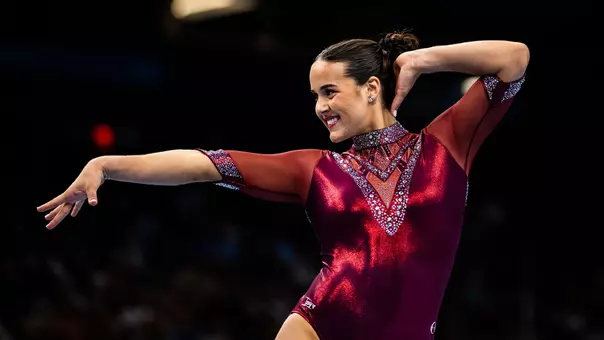
Completed Event: Women's Gymnastics versus Rutgers on April 3, 2026 , Win , 197.875, to, 196.300
Final

Women's Gymnastics
197.875
vs Rutgers
196.300


November 11, 2008 | Women's Gymnastics
By Brian MacPherson
St. Cloud Times
bmacpherson@stcloudtimes.com
May 11, 2008
Brie Olson had to stagger to her feet, blood trickling down her face, a balance beam-shaped bruise surfacing on her forehead and across her eyes.
Moments earlier, her foot had slipped out from under her right before she went into a layout (a front flip) on the four-inch-wide apparatus.
She hadn't fallen off the beam. That was the important part. The judges already were going to deduct points for her spectacular fall — insult to injury, much? — but she saved further deductions by staying on the beam.
Olson even finished the routine with a score high enough to keep her in the top 30 in her age group at last year's Junior Olympic national gymnastics meet, a meet to which she'll return this weekend (this time in Kissimmee, Fla.) with an eye on a top-10 finish.
She did all that with a concussion so severe she still has no memory of any of it.
"It was a good routine, though," she said this week. "I watched it."
It's not easy to hang onto a balance beam — and finish a routine — after enduring a crash like that. But Brie has grown up having to watch her younger brother Hunter endure so much more.
Hunter was 11/2 when doctors diagnosed him with mitochondrial myopathy, a disease that prevents the body's cells from turning nutrition into energy and interferes with the function of entire organs.
For Hunter, that meant his entire gastrointestinal tract had shut down. His brain and muscular function weren't working right, either. Doctors said they'd never seen anyone in his condition live more than four years.
That was more than a decade ago. Hunter now is 13 years old, and though he requires a full-time caretaker and constant intravenous nutrition, he made it.
And he's there every time Brie faces anything she's too tired or frustrated or afraid to do.
Hunter is beating mitochondrial myopathy; there's nothing about a nagging ankle ache that should be able to stop Brie from doing one more floor-exercise pass.
"It's having the strength to do something every day even if you're hurt or you're sore or you just don't want to do it," she said. "You go in there and you get your job done. … He could have given up at any time, but he hasn't."
Hunter's involvement in Brie's gymnastics, though, goes so much deeper than that. Without Hunter, in fact, Brie wouldn't have started gymnastics in the first place.
While many of the sport's elite athletes are tumbling by age 4 or 5, Brie had never tried gymnastics before Hunter's diagnosis. She'd played T-ball, but she spent most of her time "out in the outfield, doing cartwheels," said Clare Olson, her mother.
When Brie was 7 years old and in second grade, though, Hunter had to spend an entire year in hospitals both in San Diego, the home of one of the nation's mitochondrial specialists, and in the Twin Cities. Brie, meanwhile, stayed with friends, neighbors and even her second-grade teacher in Dassel.
Feeling as though they were neglecting their daughter while focusing on the health of their son, Rob and Clare Olson wanted to find something for her to do, something in which she could shine.
That something was gymnastics. That's what fit the personality of their little daredevil the best.
"She's a thrill-taker," Clare said. "She's a huge thrill-taker. The more of a challenge, the better she does. And that's probably why she stayed in gymnastics — she does not have a fear level."
The only thing that scared her — that still scares her — was the thing she could least control: the health of her younger brother. While she was developing into a top-level gymnast, her brother kept fighting a disease he wasn't ever expected to beat.
With Hunter as inspiration, Brie grew into one of the gymnasts most coveted by the nation's top gymnastics programs. Florida, Utah, Arizona State and Auburn all were interested. Four-time NCAA champion Alabama still was sending letters even after she declared her intention.
No other program really had a chance once Sooners coach K.J. Kindler — a native of Lake Elmo — extended a scholarship offer. Brie waited a few weeks to sort out the "what-ifs," she said, but even on the drive home from Oklahoma, she told her parents that she'd found her new home.
"They were always my first choice," she said. "It was one of my goals in life."
She'll be joining one of the best teams in college gymnastics. The Sooners have qualified for the NCAA championship meet for five straight years and will feature two former U.S. National Team members when Brie arrives as a freshman in 2009.
But she has the credentials to fit right in.
"It's intimidating," she said, "but, also, I feel like I'm just like any of them. I'm good enough to be there."
She finished third in the all-around at the state meet in March even with a fall on balance beam. She finished first at the region meet in April with another fall on the beam; first-place scores on floor exercise, vault and uneven bars balanced out a rough beam score.
If all goes well at the national meet in Kissimmee, Fla., next weekend — meaning she hits four-for-four on her routines — she could finish among the top gymnasts in the nation in her age group.
But she's spent her entire club career competing as an individual. At Oklahoma, she'll be competing with a team — and an elite team at that.
That's in part why she now trains at Twin City Twisters in Champlin — she's usually in the gym six days a week. At her gym in St. Cloud, she often only was training with one other gymnast at her level (Nebraska-bound Kassandra Nathe of Sartell). That wasn't anything like the team atmosphere she'll experience at Oklahoma.
"You're going to have a team, and you're going to need them to support you and be there for you," she said. "You always do better when you have someone to cheer you on."
Said Kim Wozniak, Brie's coach in Champlin, "She has so many facets to her personality. She can be a really positive girl and bright in a leadership role if she chooses to be. She's got that quirkiness, but she's also strong and determined and talented. All around, she's an amazing kid and an amazing athlete."
That determination, that quirkiness, and above all, that positivity — that comes from Hunter.
Hunter weighed 15 pounds when he was 2 years old, and doctors didn't give him much hope. But the 13-year-old now 5-foot-7 and 140 pounds — "He towers over me," Brie said with a smile — and still is teaching his older sister about what's really important in life.
No gymnast has a perfect day every day, after all. One of the reasons Brie has thrived in her new gym is because she has more girls with her to lift her spirits on down days. When it was just her and "Simba," as Nathe is affectionately known in the gym, the mood of one could easily affect the other.
"When it was just me and Simba, when you had a bad day, it would be obvious," she said. "It would rub off, and she would have a bad day. We'd both be crabby with no one there to pick us up."
No matter how her day goes in the gym, though, Hunter is waiting for her at home. For him, despite everything he's gone through in his life, every day is a good day.
"He's always happy," Brie said. "It's really fun to have him in the house because he cheers up anyone with his laugh or his giggle."
With a fighter like that in the family, it makes everything — even a balance beam to the face — that much easier to take.