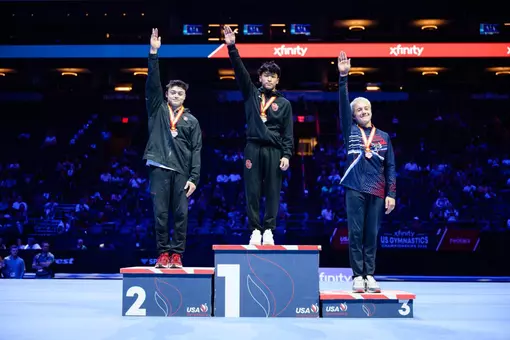
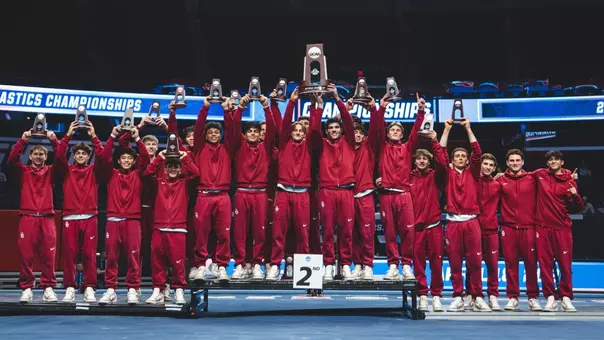
Completed Event: Men's Gymnastics versus Ohio State on April 17, 2026 , Win , 322.825, to, 320.294
Final

Men's Gymnastics
322.825
vs Ohio State
320.294


February 09, 2001 | Men's Gymnastics
Feb. 9, 2001
Q: Coach Williams, I'm a junior at Texhoma High School and would love to be a collegiate gymnast. Do high school gymnasts have any shot at making a college team?
Jacob, Texhoma, Texas
A: Here at Oklahoma we have had gymnasts from high school programs make our team in the past. Most of them ended up specializing on one or two events. Generally, high school gymnasts start training in gymnastics when they are older and end up behind gymnasts who start at a young age. Club gymnasts also frequently spend more hours in the gym. Making a college team as a high school gymnast is possible, but more difficult. Good luck!
Q: Coach Williams, I live in Texas but am an OU fan who plans to be in Norman on March 10th for your meet against Ohio State. How can I get tickets to this event?
Amanda, Campbell, Texas
A: Tickets for all of our home meets can be purchased at the door at the Lloyd Noble Center. For group tickets, or to order tickets in advance, call the OU ticket office at 405/325-2424.
Q: Coach Williams, how can gymnasts get information about college programs? Should they write to the coaches? What's the best way to express your interest in being part of an NCAA team?
Stephen, Lowell, Mass.
A: The best way to let college coaches know youre interested is to write the coaches directly and include a video tape of your performances in meets along with clips of recent practice sessions (new skills your working on, things like that). Videos should be no more than 10-15 minutes in length, if you expect the coach to watch the entire thing.
Official recruiting begins in July of the prospect's junior year in high school. Most coaches do the majority of their recruiting from July to November for the early signing period and January to April for the late signing period.
Q: Coach Williams, in the past, Olympians like Bart Conner went to college. How come young Olympians now, like the Hamm brothers, aren't competing in college?
Kerry, Shelbyville, Md.
A: Some of the best high school seniors are choosing not to go to college because they can do very well, competitively and financially, without a college scholarship.
In the past Olympic athletes could not accept training funds or prize money, so college scholarships were often the most affordable option for advanced training, but those rules have changed. Today, athletes on the US National Team are paid monthly and can apply for special grant money or earn income while performing on the national tour events.
The other concern that often keeps Olympic-level gymnasts from coming to college is time available for training. A student-athlete in college must devote a certain number of hours attending class full-time and doing the academic work to remain eligible for the NCAA program. In addition, NCAA gymnasts can only be required to train 20 hours per week. (They can train more at their own discretion.) Athletes who do not go into NCAA programs can go to school part-time, train more hours in the gym and continue working with their junior coaches. These options weren't available in the past, when the only choice was going to college and being supported through the NCAA program or train at home with no outside support.
I still like to see young athletes prepare for their future by attending college one way or the other. At Oklahoma, I feel we try very hard to prepare student-athletes for a future outside gymnastics while training them to their highest potential.
Q: Coach Williams, what do you think of the recent change, where college gymnasts compete using Olympic rules? Do you think it makes college gymnastics too hard?
Paul, Dallas, Texas
A: I, personally, was in favor of making the college rules closer to the Olympic rules. Having coached athletes in the junior program who were using the Olympic standard, it didn't make a lot of sense to make the rules easier for them when they went to college.
The reason college coaches originally modified the rules was to create more parity among the teams, which we hoped would save programs. This didn't happen. Making the rules the same as in the Olympics allows college athletes to train for both the NCAA program and the US national team, or whatever country they hail from, without having to change routines.